Categories
Featured Latest from the Lab

CAS and RUL present: A Place in the City

A Place in the City, by Dr Gabriel Silvestre, from Newcastle University’s School of Architecture, Planning and Landscape, features communities in Latin America facing displacement, segregation, and gender inequality. The film captures how ordinary people are reshaping their neighbourhoods, fighting not just for rights, but for the power to design more inclusive urban futures.


Through powerful stories from Santiago de Chile, Rosario (Argentina), and Belo Horizonte (Brazil), the film weaves together compelling commentary with archival and original footage. It is both a tribute to collective action and a call to imagine cities differently.

Categories
Featured Latest from the Lab RUL talks

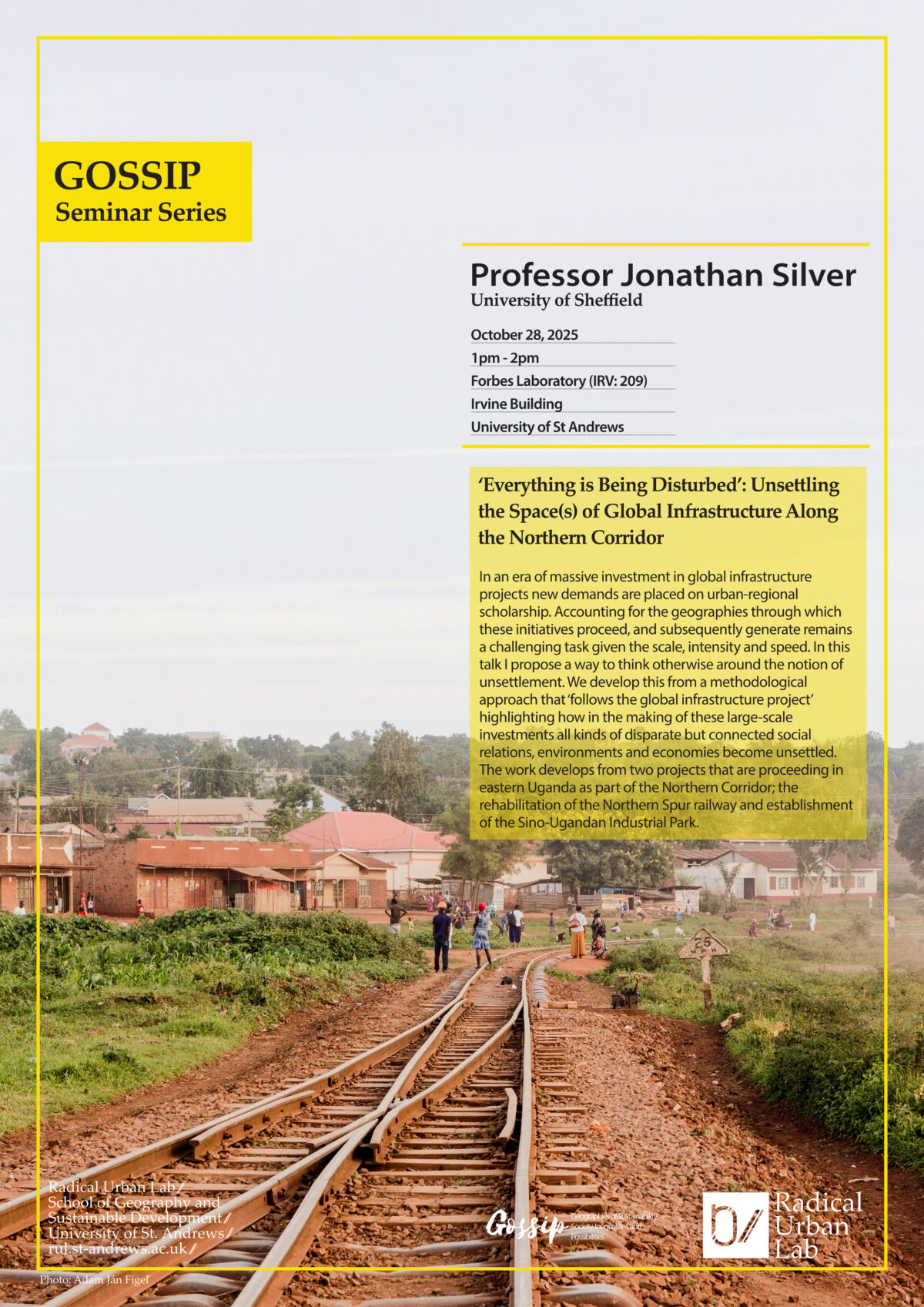
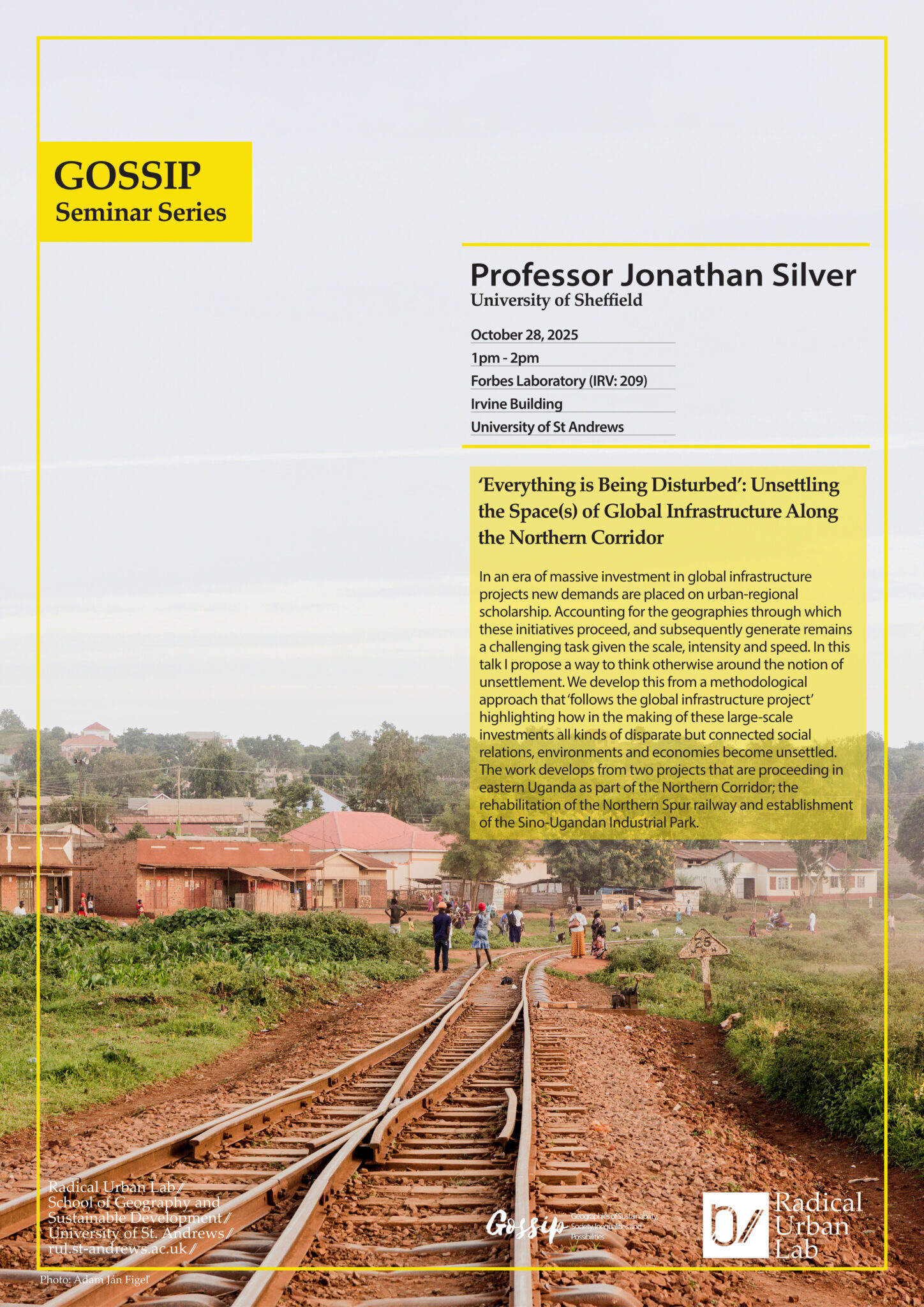
GOSSIP and RUL present: Prof Jon Silver (Sheffield) ‘Everything is Being Disturbed’

October 28, 1-2pm at the Forbes Lab in the Irvine Building.

‘Everything is Being Disturbed’: Unsettling the Space(s) of Global Infrastructure Along the Northern Corridor


In an era of massive investment in global infrastructure projects new demands are placed on urban-regional scholarship. Accounting for the geographies through which these initiatives proceed, and subsequently generate remains a challenging task given the scale, intensity and speed. In this talk I propose a way to think otherwise around the notion of unsettlement. We develop this from a methodological approach that ‘follows the global infrastructure project’ highlighting how in the making of these large-scale investments all kinds of disparate but connected social relations, environments and economies become unsettled.


The work develops from two projects that are proceeding in eastern Uganda as part of the Northern Corridor; the rehabilitation of the Northern Spur railway and establishment of the Sino-Ugandan Industrial Park.

Categories
Blog Featured Latest from the Lab

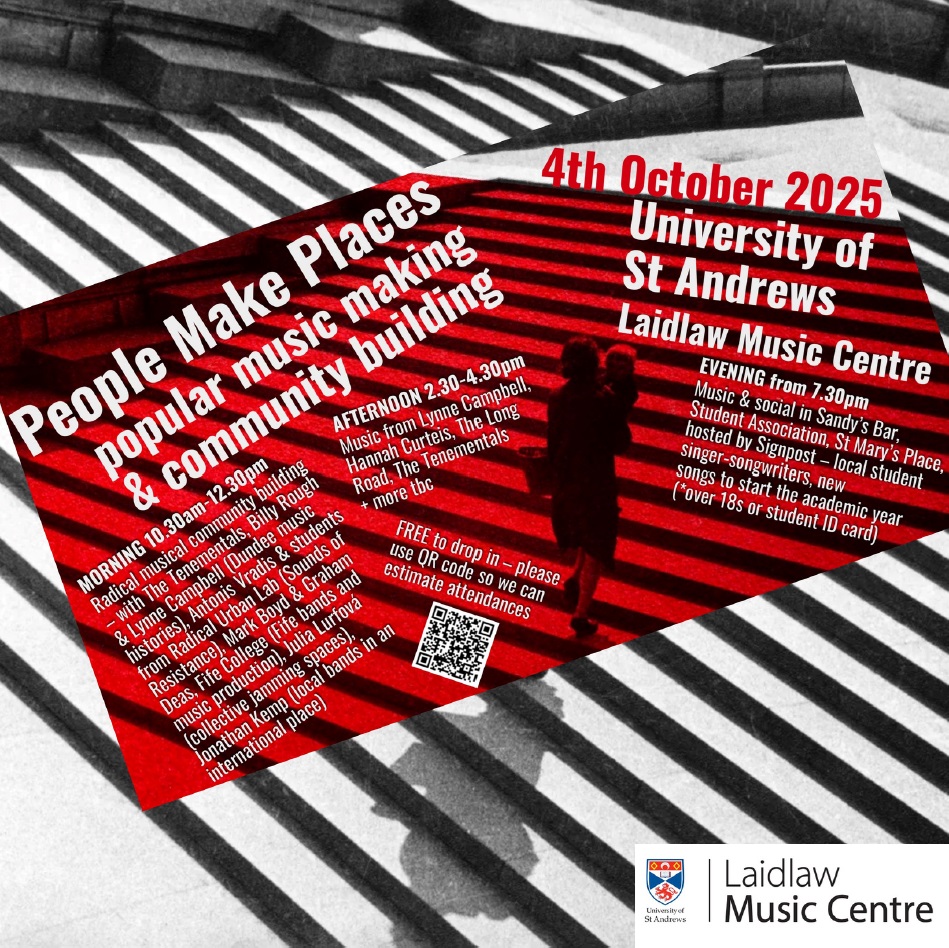
People Make Places: Popular Music and Scottish Urban Identity, day symposium, Oct 4

Our friends at the Popular Music and the Academy project are organising the fascinating-day long symposium at the Laidlow Music centre:

People Make Places: Popular Music and Scottish Urban
Identity

1-day symposium and music-making
Saturday 4th October 2025

  • Part of a larger project exploring the links between research and practice, this day involves both banter and bands. The heart of the project is the Glasgow rock band and collective The Tenementals, whose first album tells the story of Glasgow in music. How might popular music contribute to community-building here in the east of Scotland? Come and find out.
  • 10:30-12:30 Macpherson Recital Room, Laidlaw Music Centre — panel discussion and sharing research in progress
  • 14:30-16:30 Macpherson Recital Room, Laidlaw Music Centre — bands, songs, and stories, featuring The Tenementals and local Fife and Dundee musicians
  • 19:30-21:30 Sandy’s Bar, Sandy’s Bar, Students Association — new semester, new songs, from students, organised by Signpost (over 18s only due to licensing)
Categories
Featured Latest from the Lab Projects

The Forced Space: an architectural and human narrative during the war in Gaza (Hussein Naim, RUL-Gaza Fellow)

RUL is immensely proud to virtually host Hussein Naim, a Gaza-based Palestinian architect and multidisciplinary artist, as its inaugural RUL-Gaza Fellow for 2025-26. Hussein’s research explores themes of forced displacement, crisis urbanism, and the spatial consequences of war. He has led several community-based artistic initiatives, including “Reviving Memory”, a visual arts project modelling Palestinian cities under occupation, and “The Coloured History of Palestine”, a mosaic-based initiative that reconstructs collective memory in destroyed neighbourhoods. As part of his Fellowship, Hussein will be working on the Forced Space project below, partaking in all RUL activities as well as joining, and presenting at our School’s seminar series (dates tbc).

1. Introduction & Context

The war on Gaza has not only devastated its urban fabric but also redefined the very notion of space. In conditions of protracted siege, forced displacement, and relentless bombardment, the built environment becomes a stage for both survival and loss.

This research builds upon the concept of “forced space” (al-hayyiz al-qasri), a spatial condition imposed by violence, where architecture is shaped by necessity rather than design. Gaza’s urban landscape during the war offers a unique case study for examining how spatial constraints, displacement camps, and destroyed neighborhoods collectively transform human experience and architectural form.

2. Research Idea

The project aims to investigate the architectural and human dimensions of “forced space” as they emerge in Gaza during wartime. It will explore how architecture, both formal and improvised, mediates between survival needs and social identity.

This includes:

  • Mapping the transformation of public and private spaces into shared shelters, aid distribution points, and makeshift infrastructures
  • Documenting the material and spatial improvisations by residents, particularly women, who create productive spaces amidst displacement
  • Analysing how forced space alters social relations, mobility patterns, and collective memory

The research will merge spatial analysis with oral histories, producing a layered narrative that combines maps, architectural drawings, and testimonies.

3. Motivation

While much has been written about the humanitarian crisis in Gaza, the architectural dimension of displacement has received little systematic attention. Existing studies often treat space as a static backdrop, rather than as an active, evolving participant in the lived experience of war.

This research is motivated by three core objectives:

  1. To fill a critical gap in documenting architecture as a human and ethical practice during armed conflict
  2. To explore how design principles can emerge from necessity, improvisation, and resilience under extreme duress
  3. To contribute to both academic discourse and practical guidelines for architects, urban planners, and humanitarian agencies working in similar crisis contexts

4. Methodology

  • Case Studies: Detailed examination of multiple displacement sites across Gaza, including urban shelters, tented camps, and repurposed public buildings

To the extent that the situation on the ground permits, the methodology might also include:

  • Field Interviews: Collecting oral histories from residents, with attention to gender-specific spatial adaptations, especially by women who reconfigure spaces for domestic, social, and economic purposes
  • Spatial Mapping: Using architectural drawings, GIS mapping, and photographic documentation to trace spatial transformations over time

The project will adhere to ethical research standards, ensuring anonymity and informed consent for all participants.

5. Outputs

  • Academic Paper: A peer-reviewed article for journals in architecture, urban studies, and humanitarian research

It is envisaged that in a later stage, this can be used to develop a series of future outputs in return, including:

  • Atlas of Forced Space: A visual and textual compendium of spatial conditions in Gaza during the war, combining maps, diagrams, and narratives
  • Design Guidelines: A practical handbook for designing humane, adaptive, and culturally sensitive shelters in contexts of forced displacement
  • Exhibition: An interactive exhibition integrating architectural models, photographic series, and recorded testimonies, aimed at engaging both academic and public audiences

6. Expected Contribution

This research will deepen the understanding of how architecture operates under extreme duress, not merely as a physical shelter, but as a vessel for identity, memory, and resilience. It will provide an evidence-based framework that humanitarian agencies and architects can adapt in designing post-crisis environments.

By centering Gaza’s experience, the project also preserves an essential architectural memory at risk of being erased by both physical destruction and historical neglect.

Ultimately, the study aims to transform the narrative of Gaza from one of passive victimhood to one of active spatial agency, demonstrating how even in the most constrained conditions, communities shape their environments to reflect dignity, identity, and hope.

Categories
Latest from the Lab Podcasts

Introducing the Sounds of Resistance, a podcast by St Andrews Students

The Sounds of Resistance is a new podcast put together by six students at the University of St Andrews. The output of their Summer Teams Enterprise Project 2025, the Sounds of Resistance takes listeners on a sonic journey of different resistance groups, by examining political movements and changes from the late 20th Century until today.

At its core, the podcast demonstrates how music is a unique and effective form of activism. In three case studies, the students consider not only the music itself, but the reception and impact of songs, artists, and entire movements in divided societies through themes such as anti-colonialism and national identity, amongst others.

This first episode introduces the students, their research and the direction of the podcast. Give it a listen!

Categories
Blog Featured Latest from the Lab

Call for Applications: virtual RUL-GAZA Fellowship 

Introduction & Purpose

The Radical Urban Lab (RUL) at the University of St Andrews, United Kingdom, is inviting applications for a Virtual Fellowship for a postgraduate (Masters level up) Palestinian scholar from Gaza, to join us for one term during the Academic Year 2025/26. This Fellowship is developed in collaboration with the Emergency Committee of Universities in Gaza (including representatives from IUG, Al-Aqsa, and Al-Azhar Universities) and draws on a model of support outlined in the FOBZU (Friends of Birzeit University) Guide for UK-Palestinian Higher Education collaboration.

Potential Fields of Research:

Examples could include (but not limited to) one or a combination of

  • Urban studies
  • Decolonial thought
  • Genocide & scholasticide studies
  • Social & environmental justice
  • Critical cultural geography

Fellowship Benefits

  • A stipend of £1,500
  • Personalised mentorship and guidance from the RUL members
  • Invitations to RUL meetings and access to all our internal resources
  • Opportunities to collaborate with a global network of scholars and practitioners through RUL
  • Support to produce an independent piece of research, for example an article, blog post or any other creative output, such as a short film, podcast, or a photo collection.
Duration & Structure

Three months during one of the two terms of the Academic year 2025/26 (start date to be decided together with the successful applicant)

Eligibility Criteria

Applicants should:

  • Be a Palestinian national currently residing in, or having recently moved from Gaza; 
  • Be a postgraduate student enrolled in, or have recently graduated from, a public university in Gaza — such as Al-Azhar University, the Islamic University of Gaza, or Al-Aqsa University — or from one of their affiliated colleges, such as the University College of Applied Sciences (UCAS), Al-Azhar Intermediate Studies College, Al-Aqsa Community College for Intermediate Studies, or other similar institutions;
  • Demonstrate a strong interest in critical research related to urban issues, decolonisation, and/or social justice.

How to Apply

To apply, please submit the following to [email protected] by August 15, 2025. Any conventional file format (.doc, .pdf) or links to your work would be accepted:

  • A CV (1-2 pages);
  • A research proposal (up to 700 words) including an outline of the research idea, its motivation, and its potential outputs. This can be a new idea OR a project the Fellow is already currently working on, and we acknowledge the project can change along the course of the Fellowship.
  • A sample of previous work or writing. 

Timeline

  • Applications open: July 15, 2025
  • Applications close: August 15, 2025
  • Selection and notification of candidates: August 30, 2025
  • Fellowship start date: After September 16, 2025 – to be confirmed with the successful candidate.
Selection Criteria 

Applications will be evaluated based on:

  • Clarity, feasibility, and quality of the proposed research. 
  • Commitment and motivation to personal scholarly development. 
  • Willingness to contribute to the Gazan collective efforts in resisting the ongoing scholasticide. 
  • Alignment with the values and work of the Radical Urban Lab. 
About the Fellowship Provider

The Radical Urban Lab (RUL) is an interdisciplinary research collective based at the School of Geography and Sustainable Development, University of St Andrews. RUL is committed to supporting critical scholarship on urbanisation, decolonisation, and social justice. This Fellowship is offered in partnership with public universities in Gaza, as part of a shared commitment to academic solidarity and resistance against scholasticide.

Categories
Blog Featured Latest from the Lab

RUL proudly presents: Sustainable, Inclusive and Just Cities, Vol.3

The Radical Urban Lab is delighted to present the third volume of Sustainable, Inclusive and Just Cities: an enormous, collective endeavour undertaken by the Hons students of the eponymous module (SD4116) for the academic year 2024-25! Building on the work of the previous years, this year’s incredible cohort brings you a stunning collection of struggle and hope from urban communities the world over, reaching previously unexplored regions, and always bringing the message of community, perseverance, and hope. Enjoy!

Categories
Featured Latest from the Lab Reports

RUL Report #3.4 Why you should know Basaglia’s revolution

Why you should know Franco Basaglia: Italy is famous for one of the most important revolutions in the field of mental health. In 1978, a law was passed by the Italian Government that resulted in the closure of all mental health asylums. The powerful experience of activism started from a mental health asylum in Gorizia was instrumental in the passing of this law. The action was led by Franco Basaglia, an Italian psychiatrist, and his group. Basaglia was supported by a large grass-root movement consisting of mental health workers, intellectuals, patients and families, leftist activists and regular citizens.

Franco Basaglia was one of the most important intellectuals of the country in which I was born and grew up, and his experience as a psychiatrist shaped my thoughts and ideals on the meaning of being a mental health professional. Despite its importance, I became familiar with his work only after graduation. There is a clear blind spot in Italian academia on the fundamental role that Franco Basaglia played in the development of contemporary psychiatry. There are many explanations for the oblivion of this relevant political experience: Franco Basaglia was a radical critic of the institutions. He brought a radical vision of psychiatry as a discipline into the academic discourse, highlighting its political dimension, and criticizing the abuse of power and control by medical institutions. Despite widespread support from grassroots movements and civil society Franco Basaglia faced strong opposition from institutional psychiatry and Academia and, which prevented Basaglia’s group from fully achieving their goals.

Categories
Featured Latest from the Lab Reports

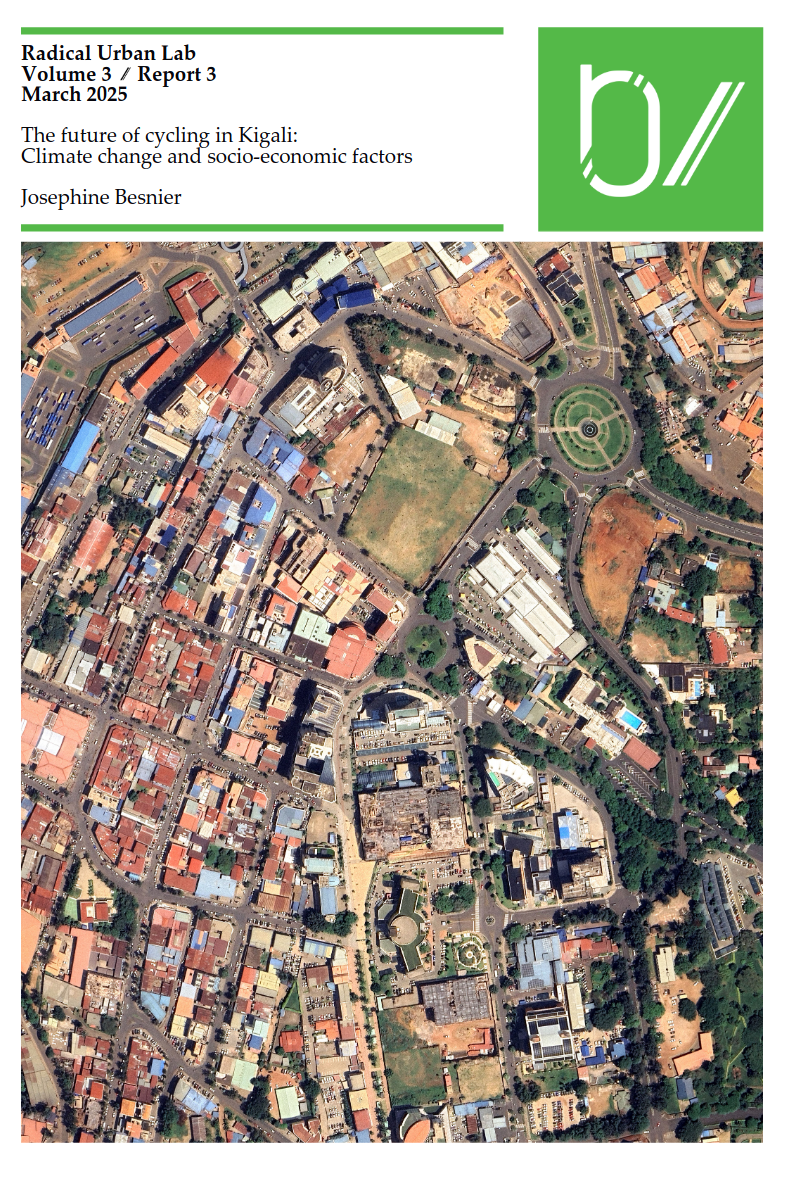
RUL Report #3.3 The future of cycling in Kigali: Climate change and socio-economic factors

With climate change on the rise, ensuring sustainable cities has become increasingly important. The normalisation of cycling as an active form of mobility has been increasingly supported as a way to combat climate change. This research explores the role of cycling in Kigali, Rwanda, to extend the geographical scope of the academic literature to the Global South, which is currently lacking. The aim of this research was to explore the future development of cycling in the city, focusing primarily on weather and socio-economic factors. This was achieved through a survey of 82 cyclists in Kigali and interviews with 5 key actors. This dissertation finds that weather plays an important role in shaping cycling habits but is currently secondary to socio-economic status. In order to ensure the future development of cycling in the city and to avoid becoming a car-centric city, the City of Kigali needs to improve cycling infrastructure and change attitudes to ensure that cycling remains attractive and that Kigali achieves its Master Plan goals.

Categories
Blog Featured Latest from the Lab Projects Protomagia

Art, politics and dissent in Plateia Protomagias: a documentary by the DtC collective (Sofia Makavou, Anna Papoutsi, Antonis Vradis)

Public space in Athens today is under attack: whether by way of rampant commercialisation, privatisation, policing or surveillance, the character of public space is undergoing a rapid, violent and unprecedented transformation. In the years since the pandemic, the city’s public spaces (parks, hills or squares) have been targeted by the authorities as targets to be pacified, and by developers as an area of potential profit. In addition, the city’s metro expansion (line 4) has commenced, meaning the long-term fencing off of some of the capital’s most emblematic and central squares (Exarcheia, Protomagias, Kolonaki, among others). Against this backdrop, authorities at all scales (municipal, prefecture, national) are exerting ever-more control over who has access to public space, and for what kind of use: event licensing, previously nearly-unheard of, is quickly becoming the norm; private enterprises are given scandalous ‘rights’ to trample over public thoroughfares, and ever-increasing policing targets already marginalised communities disproportionately. 

Migration and public space in Athens are deeply intertwined and reflect broader socio-political tensions and struggles over belonging, visibility, and rights. The city has long been a hub for migrants, especially from SWANA, and their presence in the city’s squares, streets, and parks is constantly reshaping urban life and space. Spaces such as Victoria Square, Exarcheia and Protomagias square have long functioned as sites of both solidarity and contestation, where migrants establish social networks, access support, and assert their right to the city. However, these spaces are also subject to policing, securitisation, and periodic invisibilisation and displacement, as state authorities and far-right groups seek to curtail migrant presence. Amidst austerity, rising xenophobia, and shifting migration policies, grassroots initiatives and solidarity movements continue to challenge exclusionary practices, transforming public spaces into arenas of resistance, care, and alternative forms of urban citizenship. 

The documentary explores public space in Athens today, how it is used everyday but also as a space for politics, dissent and art and by whom. We ask: is urban public space really public? Is it ever really free and open to all? Who has access, when, under what conditions and who controls access? What are the immediate and long-term implications? We take the example of Plateia Protomagias, one of the last remaining open spaces in the city. We consider it open in the sense that it has not entirely been ‘eaten up’ by Attiko Metro works. Surrounded by corrugated steel, it still is the last refuge everyday for many of the residents of the centre, and especially the overpopulated neighbourhoods of Kipseli, Patisia, Exarcheia, Gkizi and Poligono. It is also the space where many cultural and art events take place during the spring and summer months, as well as gigs and political discussions. Embarking from our own experience of co-organising a music festival with African street musicians in September 2024, we problematise the processes (internal and external) and discussions that we went through with regards to acquiring the Municipality’s permission to hold the festival there. We discuss between us and with other groups and individuals who made similar attempts, with or without permission, successful or not.

Decolonising the City (DtC) is a collective of researchers and film-makers that formed out of the namesake USF project, working on urban public space and migration, using visual and participatory methodologies.