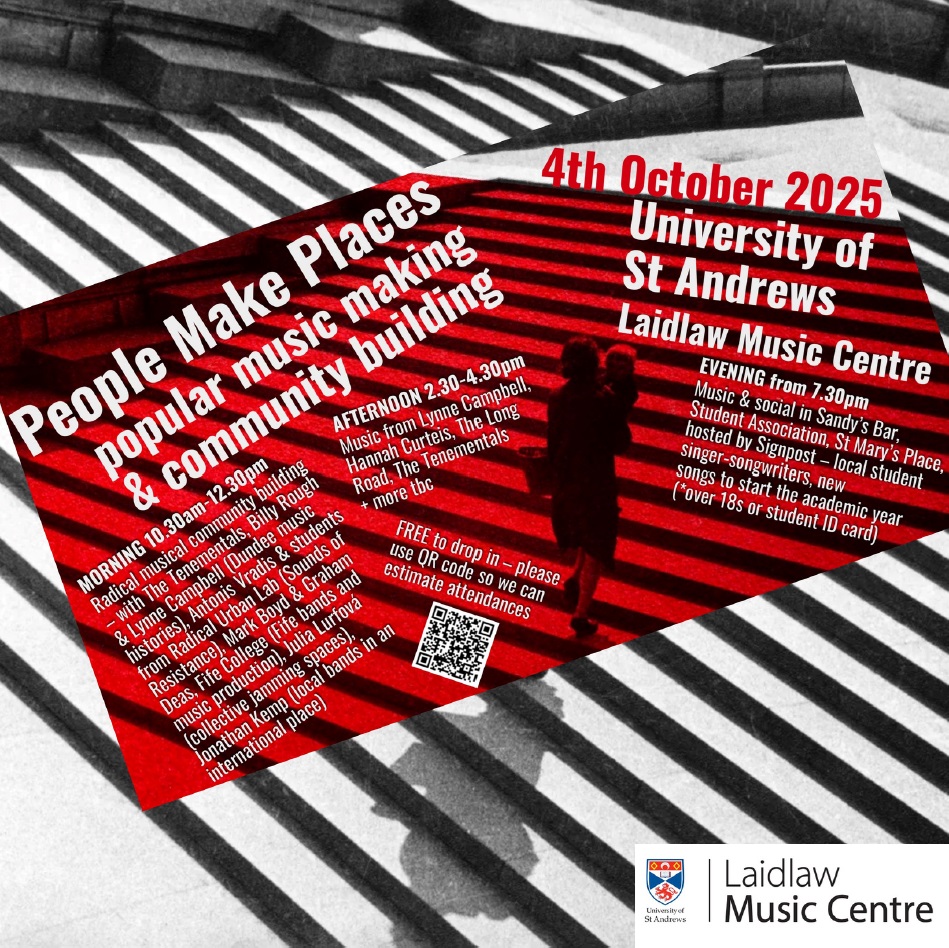
Part of a larger project exploring the links between research and practice, this day involves both banter and bands. The heart of the project is the Glasgow rock band and collective The Tenementals, whose first album tells the story of Glasgow in music. How might popular music contribute to community-building here in the east of Scotland? Come and find out.
10:30-12:30 Macpherson Recital Room, Laidlaw Music Centre — panel discussion and sharing research in progress
14:30-16:30 Macpherson Recital Room, Laidlaw Music Centre — bands, songs, and stories, featuring The Tenementals and local Fife and Dundee musicians
19:30-21:30 Sandy’s Bar, Sandy’s Bar, Students Association — new semester, new songs, from students, organised by Signpost (over 18s only due to licensing)
Examples could include (but not limited to) one or a combination of
Urban studies
Decolonial thought
Genocide & scholasticide studies
Social & environmental justice
Critical cultural geography
Fellowship Benefits
A stipend of £1,500
Personalised mentorship and guidance from the RUL members
Invitations to RUL meetings and access to all our internal resources
Opportunities to collaborate with a global network of scholars and practitioners through RUL
Support to produce an independent piece of research, for example an article, blog post or any other creative output, such as a short film, podcast, or a photo collection.
Duration & Structure
Three months during one of the two terms of the Academic year 2025/26 (start date to be decided together with the successful applicant)
Eligibility Criteria
Applicants should:
Be a Palestinian national currently residing in, or having recently moved from Gaza;
Be a postgraduate student enrolled in, or have recently graduated from, a public university in Gaza — such as Al-Azhar University, the Islamic University of Gaza, or Al-Aqsa University — or from one of their affiliated colleges, such as the University College of Applied Sciences (UCAS), Al-Azhar Intermediate Studies College, Al-Aqsa Community College for Intermediate Studies, or other similar institutions;
Demonstrate a strong interest in critical research related to urban issues, decolonisation, and/or social justice.
How to Apply
To apply, please submit the following to [email protected]by August 15, 2025. Any conventional file format (.doc, .pdf) or links to your work would be accepted:
A CV (1-2 pages);
A research proposal (up to 700 words) including an outline of the research idea, its motivation, and its potential outputs. This can be a new idea OR a project the Fellow is already currently working on, and we acknowledge the project can change along the course of the Fellowship.
A sample of previous work or writing.
Timeline
Applications open: July 15, 2025
Applications close: August 15, 2025
Selection and notification of candidates: August 30, 2025
Fellowship start date: After September 16, 2025 – to be confirmed with the successful candidate.
Selection Criteria
Applications will be evaluated based on:
Clarity, feasibility, and quality of the proposed research.
Commitment and motivation to personal scholarly development.
Willingness to contribute to the Gazan collective efforts in resisting the ongoing scholasticide.
Alignment with the values and work of the Radical Urban Lab.
About the Fellowship Provider
The Radical Urban Lab (RUL) is an interdisciplinary research collective based at the School of Geography and Sustainable Development, University of St Andrews. RUL is committed to supporting critical scholarship on urbanisation, decolonisation, and social justice. This Fellowship is offered in partnership with public universities in Gaza, as part of a shared commitment to academic solidarity and resistance against scholasticide.
The Radical Urban Lab is delighted to present the third volume of Sustainable, Inclusive and Just Cities: an enormous, collective endeavour undertaken by the Hons students of the eponymous module (SD4116) for the academic year 2024-25! Building on the work of the previous years, this year’s incredible cohort brings you a stunning collection of struggle and hope from urban communities the world over, reaching previously unexplored regions, and always bringing the message of community, perseverance, and hope. Enjoy!
Public space in Athens today is under attack: whether by way of rampant commercialisation, privatisation, policing or surveillance, the character of public space is undergoing a rapid, violent and unprecedented transformation. In the years since the pandemic, the city’s public spaces (parks, hills or squares) have been targeted by the authorities as targets to be pacified, and by developers as an area of potential profit. In addition, the city’s metro expansion (line 4) has commenced, meaning the long-term fencing off of some of the capital’s most emblematic and central squares (Exarcheia, Protomagias, Kolonaki, among others). Against this backdrop, authorities at all scales (municipal, prefecture, national) are exerting ever-more control over who has access to public space, and for what kind of use: event licensing, previously nearly-unheard of, is quickly becoming the norm; private enterprises are given scandalous ‘rights’ to trample over public thoroughfares, and ever-increasing policing targets already marginalised communities disproportionately.
Migration and public space in Athens are deeply intertwined and reflect broader socio-political tensions and struggles over belonging, visibility, and rights. The city has long been a hub for migrants, especially from SWANA, and their presence in the city’s squares, streets, and parks is constantly reshaping urban life and space. Spaces such as Victoria Square, Exarcheia and Protomagias square have long functioned as sites of both solidarity and contestation, where migrants establish social networks, access support, and assert their right to the city. However, these spaces are also subject to policing, securitisation, and periodic invisibilisation and displacement, as state authorities and far-right groups seek to curtail migrant presence. Amidst austerity, rising xenophobia, and shifting migration policies, grassroots initiatives and solidarity movements continue to challenge exclusionary practices, transforming public spaces into arenas of resistance, care, and alternative forms of urban citizenship.
The documentary explores public space in Athens today, how it is used everyday but also as a space for politics, dissent and art and by whom. We ask: is urban public space really public? Is it ever really free and open to all? Who has access, when, under what conditions and who controls access? What are the immediate and long-term implications? We take the example of Plateia Protomagias, one of the last remaining open spaces in the city. We consider it open in the sense that it has not entirely been ‘eaten up’ by Attiko Metro works. Surrounded by corrugated steel, it still is the last refuge everyday for many of the residents of the centre, and especially the overpopulated neighbourhoods of Kipseli, Patisia, Exarcheia, Gkizi and Poligono. It is also the space where many cultural and art events take place during the spring and summer months, as well as gigs and political discussions. Embarking from our own experience of co-organising a music festival with African street musicians in September 2024, we problematise the processes (internal and external) and discussions that we went through with regards to acquiring the Municipality’s permission to hold the festival there. We discuss between us and with other groups and individuals who made similar attempts, with or without permission, successful or not.
Decolonising the City (DtC) is a collective of researchers and film-makers that formed out of the namesake USF project, working on urban public space and migration, using visual and participatory methodologies.
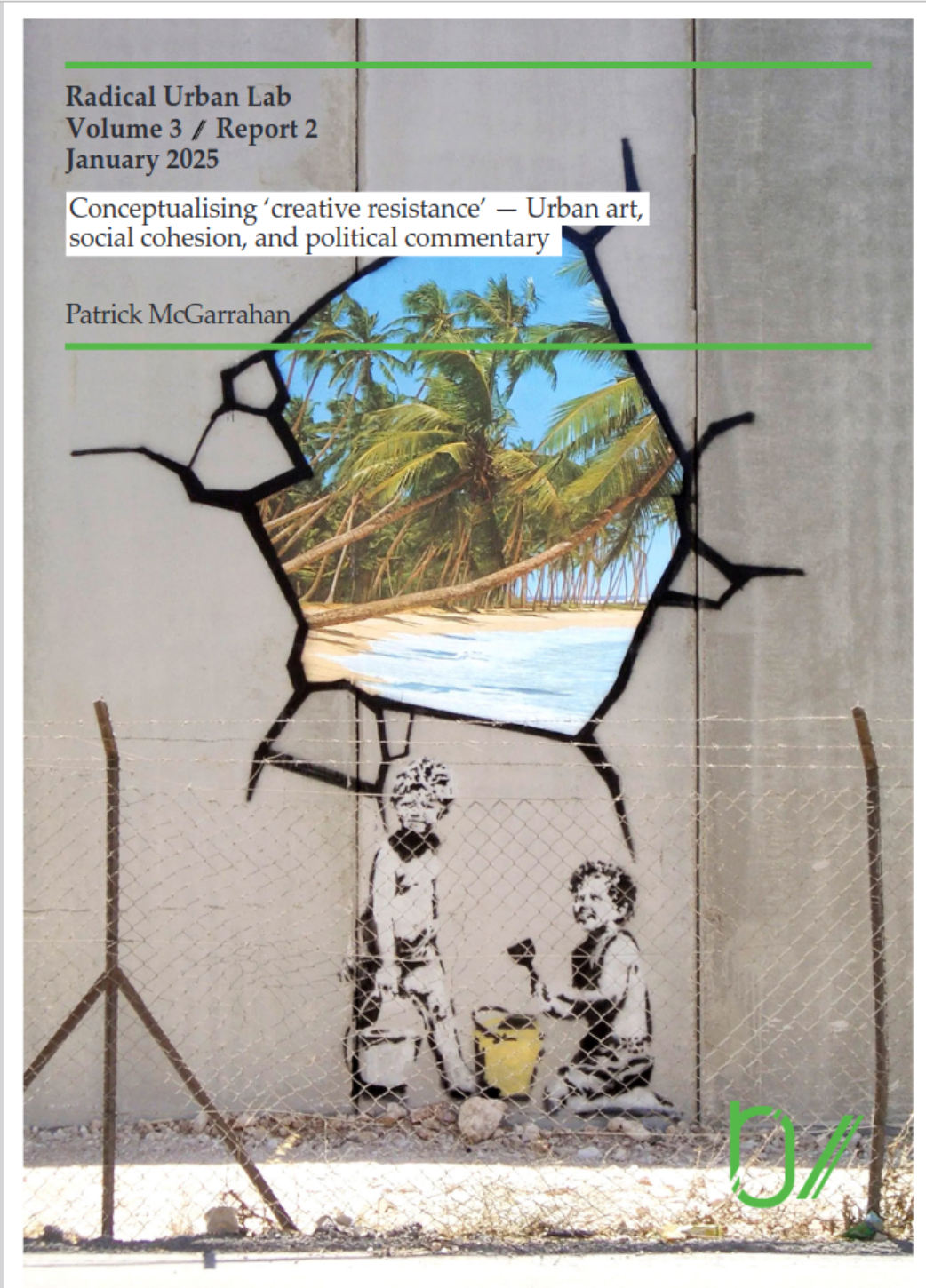
The contemporary city, though heterogeneous from context to context, is an enigma for the twenty-first-century geographer — cities serve as sites of socio-spatial exchange, as hubs of modernisation, and as agglomerates of people, all with differing visions of change and progress (Fuchs, 2012). Cities also act as meeting points between scales, as places of interaction between national, regional, and municipal decision-makers and their constituencies, which are themselves fraught with differences along cultural and demographic lines (Shatkin, 2007).
Therefore, it is within the city fabric and its constellation of stakeholders that inequality and conflict emerge, especially as cities become increasingly tethered to a global capitalist economy (Pinson and Journel, 2016). Understandably, the question that twenty-first-century researchers and policy-makers face is how to resist urban inequality. In the following work, I propose an alternative, and indeed more radical, form of resistance that hinges on the harnessing of creativity — especially artistic expression. In a growing body of scholarship that highlights this urban creative resistance, authors make a point of differentiating between ‘urban art,’ ‘street art,’ and ‘graffiti.’ in this report, I tend to use ‘urban art’ — a broader “umbrella term” that better encapsulates the various motives and media practised by artists, as well as their differing styles, narratives, histories, and geographies (Radosevic, 2013, p. 7). I also feel that ‘urban art’ avoids the murky and pejorative connotations of ‘graffiti,’ which is often synonymised with vandalism, lawlessness, and the dissolution of social order — all pre-conceptions that this work hopes to dispel.
Welcome to the RUL Sustainable Cities Art Competition!
This competition is your opportunity to showcase your creativity and imagination while contributing to the conversation on building sustainable cities. We invite you to explore how cities can be greener, more inclusive, and connected through your artwork.
Themes and Guidelines
Competition Themes
We encourage you to explore the following themes through your artwork
● Green Innovation: Explore eco-friendly solutions and green technologies in urban spaces.
● Community Connection: Reimagine cities as inclusive, accessible, and vibrant places for all.
Accepted Forms of Art
We welcome submissions in the following formats:
● Visual Art: Paintings, drawings, or mixed media pieces.
● Photographs: Capture the beauty of sustainability in your city, or through collages.
● Digital Art: Use technology to create futuristic urban designs.
● 3D Projects: Submit sculptures or urban models (photographed for submission).
Winning Categories
1. Green Innovation Award ○ Awarded for the most inventive ideas incorporating green technology and eco-friendly solutions into urban spaces.
2. Community Connection Award ○ Celebrates artwork that emphasises social sustainability and reimagines cities as inclusive communities for all.
3. People’s Choice Award ○ Voted on by the community, this award recognizes the artwork that resonates most with the public.
How to Participate
1. Create Your Artwork: Use one of the accepted formats to explore the themes of sustainable cities.
2. Submit Your Work: Deadline is the 20th of January 2024
3. Engage in the Voting Process: For the People’s Choice Award, entries will be showcased for community voting.
Your art matters
The winning pieces will be featured as part of the RUL website. By participating, you’ll contribute to a vital conversation about urban sustainability and help shape the vision of sustainable cities.
Need some inspo?
No problem, check out @staradicalurbanlab on instagram to get your creativity flowing, Deadline is the 20th of January 2024 at 12:00
Today marks a year since the commencement of the violent hostilities led by the Zionist entities in Israel in a retaliative response to the attack of the militarised Palestinian resistance organization Hamas.
The 7th of October 2023 signified the re-ignition of the aggression by the State of Israel, a condition that despite being presented as an a-historical eruption of a so-called self-defence move, is in fact a slow burning genocidal assault, perpetuated as part of Israel’s colonial settlement project.
We refuse to forget and normalise a genocide.
This podcast comes as a symbolic expression of our solidarity with the Palestinian people.
The decision to record in different languages is a deliberate one: First, to show that people across the world care about this issue while exposing the coloniality of the hegemonic English language. And second, to allow space for our emotions to grow by focusing on the rhythms, the pauses, the tones, the voices first, and the content second.
The speakers in this podcast share selected poems, personal thoughts, academic essays and journalistic articles of their choosing. By doing so they express their will to keep Palestine and Gaza alive through the act of talking about it.
The episode you are about to listen to consists of two parts. In the first part, 3 anonymous speakers read aloud poems and media articles. In the second part, you will hear a reflective narrative and an activist interview, both recorded in August 2024.
All links and sources will be available in the description box below. All credits belong to the original authors of the material shared.
Part 1: Poems and writing from Palestine
Poem 1. Noor Aldeen Hajjaj
(…) This is why I’m writing now; it might be my last message that makes it out to the free world, flying with the doves of peace to tell them that we love life, or at least what life we have managed to live; in Gaza all paths before us are blocked, and instead we’re just one tweet or breaking news story away from death. Anyway, I’ll begin. My name si Noor Aldeen Hajjaj, I am a Palestinian writer, I am twenty-seven years old and I have many dreams. I am not a number and I do not consent to my death being passing news. Say too, that I love life, happiness, freedom, children’s laughter, the sea, coffee, writing, Fairouz, everything that si joyful – though these things will all disappear in the space of a moment. One of my dream is for my books and my writings to travel the world, for my pen to have wings that no unstamped passport or visa rejection can hold back. Another dream of mine is to have a small family, to have a little son who looks like me and tell him a bedtime story as I rock him in my arms. My greatest dream is that my country wil have peace, that children will smile more brightly than the sun, that we will plant flowers in every place a bomb once fell, that we wil trace out our freedom on every wall that has been destroyed. That war will finaly leave us alone, so we can for once live our lives.
[Italian translation] (…) Questo è il motivo per cui sto scrivendo adesso; potrebbe essere il mio ultimo messaggio che arriva al mondo libero, volando con le colombe della pace per dire loro che amiamo la vita, o per lo meno, quella vita che siamo riusciti a vivere. In Gaza tutte le strade davanti a noi sono bloccate, e invece, ci ritroviamo ad un solo Tweet o una notizia di cronaca dalla morte. Il mio nome è Noor Aldeen Hajjaj, sono una scrittrice palestinese, e ho 27 anni e molti sogni. Non sono un numero e non consento che la mia morte sia solo una notizia di passaggio. Si dovrebbe dire che amo la vita, la felicità, le risate dei bambini, il mare, il caffè, la scrittura, Fairouz, e tutto ciò che c’è di gioioso. Ma, nonostante ciò, tutto scomparirà nello spazio di un momento. Uno dei miei sogni è che i miei libri e le mie scritture possano viaggiare il mondo, che la mia penna possa avere delle ali che non possono essere fermate da un passaporto senza timbro o un visto rifiutato. Un altro mio sogno è di avere una piccola famiglia, un figlio piccolo che mi assomigli e al quale possono leggere la storia della buonanotte mentre lo coccolo tra le mie braccia. Il mio più grande sogno è che il mio paese possa trovare la pace, che i bambini possano sorridere in modo più lucente del sole, e che pianteremo fiori in ogni luogo in cui una volta cadde una bomba, tracceremo la nostra libertà su ogni muro che è stato distrutto. Quella guerra finalmente finirà e ci lascerà in pace, così potremo finalmente vivere le nostre vite.
What does it mean to be a poet in times of war? It means apologizing … extensively apologizing to the burnt trees to the nestless birds to the crushed homes to the long cracks along the streets to the pale faced children before and after death to the faces of every sad or murdered mother What does it mean to be safe in times of war? It means being ashamed … of your smile of having warmth of your clean clothes of your idle hours of your yawning of your cup of coffee of your restful sleep of having alive loved ones of having a full stomach of having available water of having clean water of being able to shower and for incidentally being alive! Oh God, I don’t want to be poet in times of war
[Czech translation] 30. Října, 2023
Co to znamená být básnířkou během války? Muset se omlouvat… Omlouvat se tisíckrát Spáleným stromům Ptactvu, co ztratilo hnízda Rozbořeným domovům Puklinám lemujícím ulice Pobledlým dětem před smrtí a po ní Truchlícím matkám, obětem vrahů Co to znamená být během války v bezpečí? Muset se stydět… Za každý úsměv Za teplo domova Za čisté oblečení Za líné dny Za každé zívnutí Za hrnek kávy Za klidný spánek Za přeživší blízké Za plný žaludek Za přístup k vodě Kterou lze pít Za horkou sprchu Za náhodu, jež mi dovolila žít! Ach Bože, Nechci být básnířkou během války.
Poem 3. Ramsey Nasr: ‘We Have On This Earth What Makes Life Worth Living’
On this earth what makes life worth living: the hesitance of April the scent of bread at dawn an amulet made by a woman for men Aeschylus’s works the beginnings of love moss on a stone the mothers standing on the thinness of a flute and the fear of invaders of memories.
On this earth what makes life worth living: September’s end a lady moving beyond her fortieth year without losing any of her grace a sun clock in a prison clouds imitating a flock of creatures chants of a crowd for those meeting their end smiling and the fear of tyrants of the songs.
On this earth what makes life worth living: on this earth stands the mistress of the earth mother of beginnings mother of endings it used to be known as Palestine it became known as Palestine my mistress: I deserve, because you’re my mistress I deserve life.
[Greek translation] Μαχμούντ Νταρουίς Σ’ αυτή τη γη υπάρχει κάτι που αξίζει να το ζήσεις
Σ’ αυτή τη γη υπάρχει κάτι που αξίζει να το ζήσεις Ο ερχομός του Απρίλη Η μυρωδιά του ψωμιού την αυγή Αυτά που λένε οι γυναίκες για τους άντρες Τα γραπτά του Αισχύλου Η αρχή του έρωτα Το χορτάρι πάνω σε μια πέτρα Μητέρες που ζουν με το σκοπό της φλογέρας Και ο φόβος των κατακτητών για τη μνήμη *** Σε αυτή τη γη υπάρχει κάτι που αξίζει να το ζήσεις Το τέλος του Σεπτέμβρη Μια γυναίκα που ανθίζει μετά τα σαράντα Η ώρα του ήλιου στη φυλακή Σύννεφα που σχηματίζουν πελώριες μορφές Τα συνθήματα του λαού για κείνους που φεύγουν γελαστοί και ο φόβος στα μάτια των τυράννων *** Σε αυτή τη γη υπάρχει κάτι που αξίζει να το ζήσεις Σε αυτή τη γη, την κόρη της γης τη μάνα όλων των ξεκινημάτων τη μάνα όλων των τελειωμών Τη λέγαν Παλαιστίνη
How is it I am still alive? I’ll tell you I’m alive because there’s a temporary shortage of death. This is said with a grin, which is on the far side of a longing for normalcy, for an ordinary life. Everywhere one goes in Palestine—even in rural areas—one finds oneself amongst rubble, picking a way through, around, and over it. At a checkpoint, around some greenhouses that lorries can no longer reach, along any street, going to any rendezvous. The rubble is of houses, roads, and the debris of daily lives. There’s scarcely a Palestinian family that has not been forced during the last half century to flee from somewhere, just as there’s scarcely a town in which buildings are not regularly bulldozed by the occupying army. There’s also the rubble of words—the rubble of words that house nothing any more, whose sense has been destroyed. Notoriously, the I.D.F.—the Israeli Defence Force, as the Israeli army is called—has become, de facto, an army of conquest. As Sergio Yahni, one of the inspiringly courageous Israeli refusniks (they refuse to serve in the Army) writes: “This army does not exist to bring security to the citizens of Israel: it exists to guarantee the continuation of the theft of Palestinian land.”
Activist interview The interviewee’s name, Sam, is a pseudonym used to protect their identity. Conversation was recorded in August 2024 and took place in an outside setting with background noise. Content warning: Police violence and brutality, sexual assault.
Credits
All chants that are being heard in the podcast are recorded by the organisers. Outro clip comes from Peter Brook’s (1968) documentary Tell Me Lies. Podcast editing by anonymous volunteer. Episode published in October 2024 to commemorate events of October 2023 unfolding in the occupied territory of Palestine.
Learn more about the case of Stella Maris, former rector at the University of St Andrews:
This month’s conversation revolves around the digitalization of asylum in the Greek context. Our guests are Dr Evie Papada, a human geographer based at the Department of Political Science at the University of Gothenburg, and LL.M. Vanessa Konstantinidou, a legal practitioner working in the field of migration and human rights based in Athens, Greece.
Vanessa and Evie contextualize the digitalization of asylum processes within the broader political and historical climate of Greece. On an international level, the changes occuring after the 2016 EU-Turkey deal and during the COVID-19 pandemic are framed as efficiency improvements. However, Evie and Vanessa stress that the ongoing experimentation with asylum processes brings about a complex range of issues, including the protection of personal data, quality control, and further separation between asylum seekers and governmental bodies.
Logo credits: Alma Hummelsberger Editor: Eden Igwe Music: Matthew Lewis (@matthewlewy on Spotify)
Let’s Step Outside (LSO)is a podcast series bringing urban-related activism and exciting research outside the walls of Academia and one step closer to people who don’t fancy talking with jargon. LSO’s episodes feature mainly women researchers/speakers at all stages of their career, as well as a range of activists engaged with all things urban. Delicious food for thought delivered to your ears.
In this month’s episode, we are joined by Thi Bogossian, a Brazilian geographer who recently passed their viva at the University of Surrey’s Sociology department. Thi’s ethnographic PhD focused on experiences and perceptions of Polish schoolchildren in the socio-political context of post-Brexit Britain. The project’s findings make for a fascinating conversation, which spans the themes of migration, belonging, navigating multiple identities, relating to more-than-human materialities, and creative participatory methods that can capture children’s lifeworlds.
Towards the end of our conversation, we delve into critical pedagogies that have left Thi particularly inspired to create change in the classroom. We address the current state of the neoliberal academic landscape and try to envision how it could be shaped by collective resistance.
Logo credits: Alma Hummelsberger Editor: Eden Igwe Music: Matthew Lewis (@matthewlewy on Spotify)
Let’s Step Outside (LSO)is a podcast series bringing urban-related activism and exciting research outside the walls of Academia and one step closer to people who don’t fancy talking with jargon. LSO’s episodes feature mainly women researchers/speakers at all stages of their career, as well as a range of activists engaged with all things urban. Delicious food for thought delivered to your ears.
In June’s episode, we are joined by Dr Gaja Maestri, an interdisciplinary social scientist based at Aston University (Birmingham, UK). Gaja’s research interests span across themes of social inequality, migration, gender, and bordering (on both national and domestic scales).
In this conversation, Gaja delves into affects connected to migrant support work – in particular, the differences between compassion, pity, and solidarity. She offers a nuanced perspective on politics involved in pro-migrant volunteering and activism. Towards the end of the episode, Gaja introduces her current project concerning migrant experiences of mothering.
Logo credits: Alma Hummelsberger Editor: Eden Igwe Music: Matthew Lewis (@matthewlewy on Spotify)
Let’s Step Outside (LSO)is a podcast series bringing urban-related activism and exciting research outside the walls of Academia and one step closer to people who don’t fancy talking with jargon. LSO’s episodes feature mainly women researchers/speakers at all stages of their career, as well as a range of activists engaged with all things urban. Delicious food for thought delivered to your ears.