
Author Positionality
Fikirtepe is a neighbouring district to my grandmother’s house, in which I have spent most of my holidays. Consequently, the gentrification-led displacement and the economic hardships I witness in Fikirtepe, albeit with some distance, are topics that are close to my heart. Over the course of twenty-one years, I have frequently visited my family in Istanbul and the transformations between my visits have been apparent. Driving from the European side – where the airport is located – to my family home across the Bosphorus, the results of profit-driven modernisation have always been evident to me. This transformation not only changed the physical landscape of Istanbul, but it has also had a profound impact on the livelihoods of the citizens and the social fabric that characterised the neighbourhood.
The higher prevalence of ‘gecekondus’ – or unauthorised developments – in this part of the Anatolian side of Istanbul made it more susceptible to urban redevelopment and gentrification. Fikirtepe, once a shanty town composed of little shacks and poorly built structures that I distinctly remember passing daily in the car, can now be seen from miles away as contemporary high-rises steadily replace the old shanties.
It is important to acknowledge that my upbringing primarily stems from an upper-class background. Thus, my exposure to the challenges faced by lower-income and migrant communities is limited beyond the research I have done for the purpose of this Community Briefing. Furthermore, the findings of this briefing are meant to offer an additional perspective to the ongoing discourse on gentrification and should be regarded as complementary to the existing viewpoints of the Fikirtepe community.
Introduction
A severe housing crisis has persisted in Turkey as a result of profound economic instabilities driven by a staggering inflation rate of 61.53% (TUIK, 2023). Today, rent prices have spiked, with an annual increase of 145.6% in Istanbul (Mays, 2022). The housing crisis is further exacerbated by the influx of migrants following the devastating earthquakes that struck southern and central Turkey in February (Karabat, 2020). Despite these existing challenges, ongoing urban transformation initiatives supported by the Turkish President, Recep Tayyip Erdogan, continue to be implemented in municipalities throughout Turkey, notably in Istanbul, aggravating these issues (Lepeska, 2014). These initiatives focus on shanty towns as well as seismic-vulnerable buildings; the need to retrofit or demolish these structures is undeniable. However, vulnerabilities created by seismic risk have become a convenient pretext for exploitative developers seeking to profit from the area’s prime location and the allure of high-rise living. These urban development initiatives have also intensified a multitude of social justice issues. Foremost among these issues is the exacerbation of economic inequality. The displacement of low-income residents due to rising rent and property values has become a disconcerting reality, often leading to homelessness and housing instability. The upper middle class increasingly supplanting the lower-income demographic in gentrifying neighbourhoods, has driven up the overall cost of living. This surge in living costs poses substantial challenges for lower-income residents in procuring basic necessities. The resultant economic inequality intensifies existing disparities within Istanbul and emphasises the need for social justice reform. Furthermore, gentrification in areas such as Fikirtepe tends to disproportionately affect lower-income Eastern Anatolian migrant communities, thereby aggravating ethnic disparities. The third dimension of concern relates to the displacement of residents and its impact on the erosion of cultural and social ties as residents are forced to vacate their homes for the means of ‘urban transformation’. The influx of newcomers due to this displacement reshapes the neighbourhood’s character by eroding its cultural identity and the traditions of the community, further marginalising its residents. This is particularly significant in the Turkish context, where community and neighbourly relations hold intrinsic value in the cultural fabric.
I recommend a comprehensive strategy that includes zoning policies and public funding, community land trusts and tenant protection initiatives, as well as local and community-based efforts. Additionally, I propose the expansion of existing community initiatives to effectively address and combat gentrification challenges in Fikirtepe.
History of the Community
Fikirtepe, situated in the Anatolian part of Istanbul within the Kadikoy district, has a rich history that has revolved around its close-knit and diverse community. Fikirtepe’s transformation began in the 1950s with an influx of immigrants from the Black Sea coast, seeking better economic opportunities in the rapidly industrialising Istanbul. In the absence of social housing policy, as well as uncontrolled and unplanned urbanisation, the migratory flows resulted in informal settlements called ‘gecekondus’ (translates directly to ‘laid at night’) on the peripheries of the city at the time. Consequently, Fikirtepe transformed into a shanty town, expanding as more immigrants arrived. These immigrants were predominantly friends and family from regions such as Sinop, Kastamonu, and Rize, which fostered a strong sense of community in Fikirtepe. This sense of community remained decades after their first settlement due to their prior connections from their hometowns. As the city sprawled outwards, Fikirtepe transitioned from its former status as a suburban outlier of Istanbul, to becoming part of the urban landscape and a centrally located district. Today, Fikirtepe’s location has made it an appealing candidate for gentrification, given its proximity to the Central Business District of the Anatolian side. Approximately half of its built infrastructure – accommodating up to 70% of its population – developed beyond the scope of institutionalised planning.
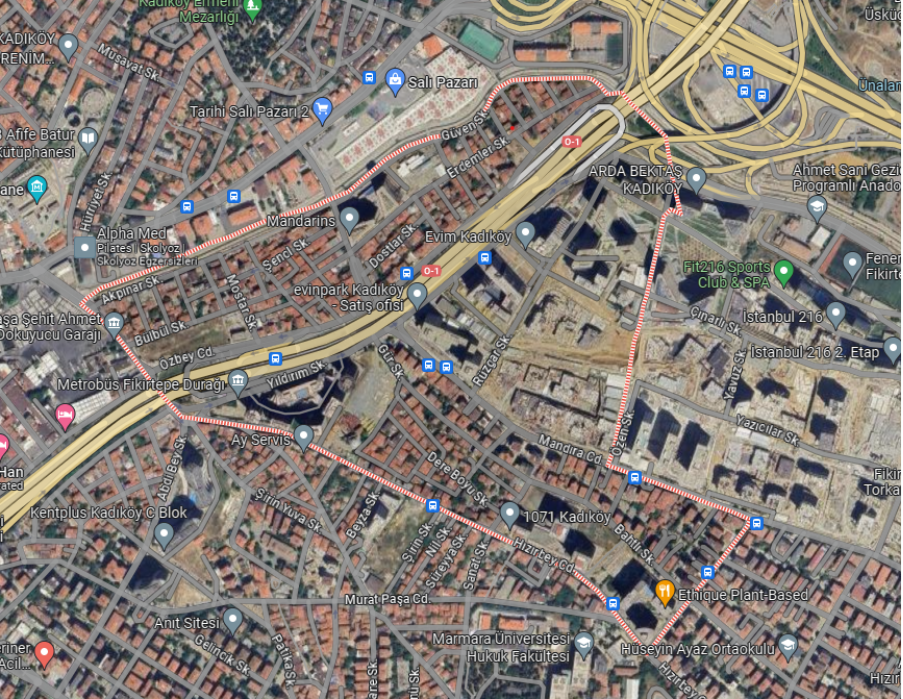
Current satellite image of the gentrifying neighbourhood of Fikirtepe in Istanbul outlined in red (Google Maps, 2023)
Existing policy and governmental actions
Despite ongoing efforts since the 1990s, a lack of legislative action and governmental intervention persists in Istanbul. Habitat II – officially known as the “United Nations Conference on Human Settlements” was held in Istanbul in 1996 (UN, 1996). This conference aimed to address urban sustainability issues, including housing, quality of life in cities, and human settlements; all of which are affected by gentrification (UN, 1996). A significant document emanating from this conference called the “Istanbul Declaration on Human Settlements” outlined global objectives and principles for sustainable urban development (OICRF, 2006). A key concept in this document emphasised the significance of addressing urban challenges such as informal settlements, inadequate housing, and homelessness (OICRF, 2006). This could have played a crucial role in mitigating the effects of gentrification in Fikirtepe. Nevertheless, despite shaping the global discourse on urbanisation, there have been no substantial government endeavours to achieve these goals. Additionally, the conference stressed the necessity of participatory planning and community engagement, both of which have not been adhered to by the Justice and Development Party, led by the Turkish President Recep Tayyip Erdogan. Provided that these principles are effectively incorporated into policies and practices by governments and urban planners, this declaration has the potential to mitigate the impacts of gentrification in Fikirtepe.
One initiative aimed at integrating the principles from the Istanbul Declaration on Human Settlements is the Urban Renewal Rent Subsidy (Yeni Safak, 2023). This program offers rental and relocation assistance for a period of eighteen months to tenants residing in buildings deemed as ‘risky’ through contractor evaluations. Those who reside in properties within the urban transformation zone receive a two-month rental subsidy. In Istanbul, this subsidy amounts to 3,500 Turkish liras per month, which is equivalent to 102 British pounds. In addition to enhancing structural safety and safeguarding against seismic-risk prevalent in shanty towns such as Fikirtepe, the Urban Renewal Rent Subsidy also plays a pivotal role in addressing the impacts of gentrification in Istanbul. The eighteen-month and two-month subsidies for beneficiaries and tenants, respectively, function as a buffer against the displacement of Fikirtepe’s residents in the face of Urban Transformation. This allows long-term residents to remain in their neighbourhoods, thereby fostering socio-economic diversity by preserving the character and cultural dynamic of Fikirtepe.
Existing community responses
TMMOB Chamber of Architects
A community response to gentrification in Fikirtepe is facilitated through the Union of Chambers of Turkish Engineers and Architects, specifically the TMMOB Chamber of Architects division (MO, 2021). Established in 1954, the TMMOB Chamber of Architects is a constitutional professional organisation founded to serve the public and society’s interests (MO, 2022). Its focus is on architecture and urban planning through advocacy and various other initiatives. Firstly, the Chamber advocates for the transparency and accountability of developers and government agencies involved in the urban transformation processes. For instance, in 2019 the Chamber led to the successful cancellation of the stage plans of the Fikirtepe Urban Transformation Project through legal action (MO, 2022). The report for the plans revealed inconsistencies in the text and tabular data, as well as calculation errors which would have resulted in a “hidden density increase” (MO, 2022). Consequently, the efforts of the chamber aided in the prevention of issues such as overcrowding or lack of living space for residents, safeguarding their overall quality of life. Moreover, the Chamber plays a substantial role in advancing social justice and mitigating the impacts of gentrification in Fikirtepe through community engagement. Aside from the affordability issue, the most significant form of displacement is the changing social fabric as the middle-class relocate into the modern high-rise buildings that have replaced the shacks that the residents once called home. Many residents have protested that “the rebuilt houses are not designed according to the lifestyle and needs of the gecekondus families living in Fikirtepe”, and thus the social dynamic and character of this district is taking a turn for the worse (Markoc, 2019). The chamber assists in amplifying the voices of the community to advocate for policies and plans that prioritise the interests of all community members, particularly the ones of marginalised and vulnerable populations.
Tasarim Arastirma Katilim (TAK) Fikirtepe
TAK is a design and research organisation based in Turkey, that believes that socially oriented design has the power and potential to shape existing systems and society for the better by considering the role of the designer and user through a shift towards participatory and collaborative design in an approach inclusive to contemporary social and political aspects (TAK, 2023). To minimise the social repercussions created by spatial intervention such as urban transformation, TAK developed the ‘Social Impact Sensitive Design’ method – a community-oriented and participatory design process, which focuses on the life dynamics and expectations of the residents for the future of Fikirtepe. This allows the designers at TAK to develop principles, strategies, and tools to establish a horizontal hierarchical, democratic structure instead of Erdogan’s top-down, authoritarian approach to the Fikirtepe Urban Transformation project (TAK, 2023). In addition to creative disciplines, various stakeholders and actors from different fields are also involved in this process, for more holistic solutions. An example of their work in Fikirtepe is the Urban Transformation Workshop, which allowed participants from different disciplines to discuss the planning, architecture, transportation, and social problems in Fikirtepe interactively to develop a critical and comprehensive understanding of the multifaceted nature of Urban Transformation and gentrification, from participants who are directly impacted by it (TAK, 2018).
Another way in which TAK provided a community-based response to the gentrifying neighbourhood of Fikirtepe, is through the “We are from Fikirtepe!” short film workshop (Tak, 2013). To encourage a sense of community and belonging as the urban structure of Fikirtepe rapidly changes, the Film TAK program, conducted by volunteer project coordinators from various fields, documented the life, stories and voices, of eleven participants between the ages of six and eleven (Tak, 2013). This was significant in maintaining the urban memory of the community and sustaining neighbourly relations. The screenings, first held on the 16th of November 2013, not only raised awareness of the neighbourhood’s history and dynamics, but also fostered a sense of community in Fikirtepe (Tak, 2013). Through these films, the residents find a platform to connect, share their own narratives, and preserve the essence of their neighbourhood to reinforce the bonds and ‘brotherly’ relations that have long defined the cultural and social fabric of Turkey.
Recommendations for the community
Zoning Policies and Public Funding
There are numerous policies, which if effectively implemented, could significantly reduce the displacement of low-income populations from their homes (Bolton, 2020). For instance, implementing overlay zoning for affordable housing may require demolished housing units to be replaced with affordable housing, which in turn, could reduce the demolishment of existing low-income housing by acting as a disincentive (Bolton, 2020). Additionally, overlay zones can be used to control the density and land use within neighbourhoods, for instance by limiting the number of units that can be built, which stops houses from being redeveloped into high-density apartments. This makes the area less profitable, and thus also less appealing to Erdogan’s goals of profit-led modernisation. Additionally, inclusionary zoning would create more affordable units within the gentrifying area for lower-income individuals and families, consequently preventing their dispossession (Bolton, 2020). Building on this, securing more public funding through government agencies, partnerships, and funding agencies would provide the necessary financial resources to construct and maintain affordable units (Bolton, 2020). These funds can be allocated to land acquisition, construction expenses, and operational costs to ensure that the new housing remains affordable for low-income residents. By enhancing public funding, developers can not only create more units, but also maintain lower rates, directly countering the pressures of gentrification and addressing the needs of vulnerable communities in Fikirtepe.
Community Land Trusts and Tenant Protection Initiatives
A more extensive approach to preserving housing which offers collective ownership to ensure community stewardship of land is through Community Land trusts (CLTs). CLTs are community-based organisations often initiated and managed by local communities to ensure affordable housing whilst protecting residents against the impacts of gentrification such as displacement. CLTs work towards preventing developers from displacing low-income residents by inhibiting the development of expensive infrastructure targeted to upper-class citizens, in addition to ensuring that the current residents can benefit from the investments in their neighbourhood, as a strong CLTR captures the economic value generated from these developments for residents (Cole et al., 2023). CLTs can also be utilised in moving housing from market to community ownership which combats gentrification by reducing the influence of profit-driven real estate prices (Burrowes et al., 2022). Consequently, ameliorating the affordability and stability of housing over the long-term. Furthermore, CLTS help provide low- and middle-income property-owners with the opportunity to build equity and provide more protection against foreclosures by significantly reducing the initial purchase price, making homeownership more accessible. CLTs protect homeowners from the risk of losing their homes in foreclosure due to unaffordable market prices by imposing resale restrictions, ensuring that the property remains affordable for future buyers.
Despite the presence of rental assistance programs implemented by the Turkish government in Fikirtepe, these programs often inadequately meet the residents’ requirements to sustain their quality of life or force them to relocate to cheaper housing in more affordable neighbourhoods in the peripheries of Istanbul. Thus, I recommend Tenancy right-to-counsel programs, which not only provide low-income renters facing economic difficulties with emergency funds to pay rent, but also provide access to legal representation for renters who may be facing eviction (Cole et al., 2023).
Local and Community-based Initiatives
Local Non-profits and legal groups
Fikirtepe would also benefit from an eviction aversion initiative, which has proven to work well in numerous cities such as Cleveland in the US (Cole et al., 2023). This proactive approach is designed to prevent evictions by addressing underlying issues that may trigger them, through facilitating open communication between tenants and property owners to resolve disputes and miscommunications, thereby preventing eviction as an outcome (Cole et al., 2023). Also known as the Eviction Diversion Program, both rental assistance and legal counsel are offered to avoid eviction, increase housing stability, and reduce homelessness. These factors would alleviate the issues of gentrification evident in the case of Fikirtepe.
Urban grassroots and justice organisations
Urban grassroots movements are incredibly important in the combatting of gentrification in Fikirtepe, as these initiatives are organised by residents and local activists, characterised by their bottom-up approach, which allows ordinary citizens to take the lead in identifying problems, mobilising resources, and driving solutions tailored to the needs of their community to improve the quality of life in their neighbourhood (Can, 2022). This collective action and community engagement brings people together as a united front and leverages this power of collaborative work to foster change. Activism through these movements, particularly to fight increasing rent prices and decreasing affordability in the Fikirtepe rental housing market, would be influential in resisting state-led urban transformation and the processes of gentrification (Can, 2022). Foremost, negotiations with the municipality aimed to collectively represent property-owners’ rights would ensure that individual properties were not sold without the organisation’s knowledge (Islam et al., 2015). This strategy counters the municipality’s pressures on property-owners individually, to sell their estates. Resorting to legal action in the case that these negotiations fail hasn’t worked in the past when looking at case studies such as the Taralbasi project in Istanbul, which participated in juridical battles, challenged the project in local court and the European Court of Human Rights, and applied to UNSECO for aid, and was not successful (Islam et al., 2015). However, through its media coverage, it brought international awareness to the project, increasing the support of other organisations such as Amnesty International, which helped amplify the message of the Taralbasi residents, and put pressure on local authorities to implement more inclusive and socially responsible policies that prioritised the well-being of the community over profit-driven gentrification (Islam et al., 2015). Fikirtepe can consider implementing a similar approach to address its policies and enhance its inclusivity.
Sustaining and Broadening Existing Community Initiatives
The efforts of the TMMOB Chamber of Architects and TAK Fikirtepe to counter gentrification in Fikirtepe have been pivotal in advancing social justice and mitigating the impacts of the gentrifying neighbourhood. Not only have these two organisations worked towards preventing the displacement of Fikirtepe’s residents but they have also made substantial efforts in maintaining the cultural and social fabric of the area, as well as its urban memory. Therefore, I recommend that these initiatives continue to support the community and its own diverse needs, whilst expanding their work into various other branches. For instance, the Chamber of Architects could organise a plethora of educational programs to inform residents about the implications of urban transformation projects, empowering them to actively participate in decision-making processes with a more educated approach. Furthermore, both the Chamber and TAK can involve more stakeholders, including governmental bodies to achieve a more holistic understanding of gentrification issues specific to Fikirtepe, and encourage collaborative solutions, benefitting both its residents and the state.
Conclusion
In conclusion, the ongoing challenges faced by the Fikirtepe community in light of gentrification are not just a matter of academic concern but hold personal significance to many Turkish communities witnessing the transformation of the district over the years. The consequences of profit-driven modernisation are not merely physical changes but profound impacts on the livelihoods of the citizens and the social fabric that once characterised the neighbourhood of Fikirtepe. The housing crisis in Turkey, exacerbated by economic instability, soaring rent prices, and an influx of migrants putting pressures on urban density, is further intensified by urban transformation initiatives driven by financial motives. These initiatives, while claiming to address seismic risks and encourage sustainable urban development, have often led to the displacement of low-income residents, economic inequality, and the erosion of social and cultural ties, which presents multifaceted challenges that require comprehensive and community-based responses to combat state-led gentrification.
Existing policies and government actions have failed to effectively mitigate the impacts of gentrification in Fikirtepe. Although initiatives such as the Urban Renewal Rent Subsidy Program has potential to combat issues created by gentrification, by providing some relief, it has not been sufficient in countering gentrification in Fikirtepe. Therefore, it is imperative to explore a range of initiatives to protect the lower-income community of Fikirtepe, as well as its cultural foundation.
Thus, I turn back to the recommendations that have been made in this Community Briefing. Foremost, I propose the implementation of zoning policies and public funding that promote and maintain affordable housing. In addition to these, Community Land Trusts, tenant protection initiatives and eviction aversion programmes can further prevent the displacement of residents and maintain housing stability. Furthermore, local non-profits, legal groups, urban grassroot movements, and justice organisations can play substantial roles in advocating for the rights of property-owners and tenants, whilst also bringing international attention to the challenges faced by the Fikirtepe community to apply pressure on local authorities in the implementation of socially responsible policies. Moreover, community responses that TMMOB Chamber of Architects and TAK Fikirtepe have already implemented, have played a sizable role in combatting gentrification, thus, the expansion and continuation of these initiatives would continue to encourage collaborative solutions tailored to the needs of the community.
Combatting gentrification in Fikirtepe is a complex challenge, however, I believe that with the implementation of the recommendations mentioned in this briefing, it is possible to protect the interests of the community, preserve the cultural fabric of the district, and promote social justice in the face of urban transformation. The path forward requires collaborative action and commitment to the welfare of the Fikirtepe community.
Reference List
Adhem, J. (2023). ‘Europe’s housing crisis: Portugal, Turkey, and Luxembourg struggle to find solutions’. Available at: Europe’s housing crisis: Portugal, Turkey, and Luxembourg struggle to find solutions | Euronews (Accessed: 18 October 2023).
Bolton, C. (2020) “Enacting critical community development through anti-gentrification policy advocacy”. Community Development Journal, 57(2), pp. 213-233. https://doi.org/10.1093/cdj/bsaa049
Burrowes, K., Velasco, G., Eldridge, M. (2022) ‘Centering Community Ownership and Voice to Combat Green Gentrification’, Housing Matters, 4 May. Available at: Centering Community Ownership and Voice to Combat Green Gentrification | Housing Matters (urban.org) (Accessed: 23 October 2023).
Can, A. (2022) ‘how gentrification works in Istanbul, Turkey, ways to resist it and where we are falling short’, minim-municipalism, 24 January. Available at: How gentrification works in Istanbul, Turkey, ways to resist it and where we are falling short · Minim (minim-municipalism.org) (Accessed: 25 October 2023).
Cole, V. S. H., Anguelovski, I., Triguero-Mas, M., Mehdipanah, R., Arcaya, M. (2023) “Promoting Health Equity through Preventing or Mitigating the Effects of Gentrification: A Theoretical and Methodological guide”, Annual Review of Public Health, 44(1), pp.193-211. https://doi.org/10.1146/annurev-publhealth-071521-113810
Google Maps, ‘Fikirtepe, Kadikoy, Istanbul’. Available at: https://www.google.com/maps/place/Fikirtepe,+34720+Kadıköy%2Fİstanbul/@40.9938323,29.0466355,16z/data=!4m6!3m5!1s0x14cac7f4b77f7c39:0x63458a923ce48ef6!8m2!3d40.9943025!4d29.0503567!16s%2Fg%2F120s_7hq?entry=ttu. (Accessed: 23 October 2023)
Islam, T., Sakizlioglu, B., (2015) ‘Thirteen: The making of, and resistance to, state-led gentrification in Istanbul, Turkey’ in Lees, L., Shin, H. B., Lopez-Morales, E. (eds), Global gentrifications: Uneven development and displacement. Bristol: Policy Press Scholarship Online, pp.246-264.
Karabat, A. (2020) ‘Istanbul shantytown residents in limbo’. Available at: Istanbul shantytown residents in limbo | Qantara.de (Accessed: 18 October 2023).
Lepeska, D. (2014) ‘Istanbul’s gentrification by force leaves locals feeling overwhelmed and angry’. Available at: Istanbul’s gentrification by force leaves locals feeling overwhelmed and angry | Cities | The Guardian (Accessed: 18 October 2023).
Markoc, I. (2019) “The Second Migration of Poverty: Fikirtepe, Istanbul”, International Journal of Social Humanities Sciences Research (JSHSR), 6(42), pp. 2858-2868. DOI: 10.26450/jshsr.1422.
Mays, J. (2022), ‘159 Percent Rent Increase in the Last Quarter of 2022’, Prime Property Turkey, 6 December. Available at: rent increase in Turkey in 2022 (primepropertyturkey.com). (Accessed: 26 October 2023).
Mimarlar Odasi. (2022) ‘About the Chamber of Architects’. Available at: About the Chamber of Architects – Chamber of Architects Istanbul Metropolitan Branch (mimarist.org) (Accessed: 17 October 2023).
Mimarlar Odasi. (2022) ‘An expert report was prepared in the lawsuit filed with the request for the cancellation of the zoning plans related to the Fikirtepe region’. Available at: An expert report was prepared in the lawsuit filed with the request for the cancellation of the zoning plans related to the Fikirtepe region – Chamber of Architects Istanbul Metropolitan Branch (mimarist.org) (Accessed: 18 October 2023).
Mimarlar Odasi.(2021) ‘New Zoning Plans in Fikirtepe: A Cancellation Lawsuit Was Filed Against the Stage Plans of the Transformation Project’. Available at: New Zoning Plans in Fikirtepe: An Annulment Lawsuit Has Been Filed Against the Stage Plans of the Transformation Project – Chamber of Architects Istanbul Metropolitan Branch (mimarist.org) (Accessed: 18 October 2023).
Sosyal Tasarim Platformu (2023) ‘Purpose’, TAK. Available at: Purpose – Social Design Platform (sosyaltasarimplatformu.com). (Accessed: 21 October 2023).
Tasarim Arastirma Katilim, (2023) ‘Social Impact – Responsive Design’. TAK. Available at: Social Impact :: TAK (takortak.org) (Accessed: 21 October 2023).
Tasarim Arastirma Katilim, (2018) ‘Urban Transformation Workshop in the Case of Fikirtepe’. TAK. 28 April. Available at: Urban Transformation Workshop in the Case of Fikirtepe :: TAK (takortak.org) (Accessed: 21 October 2023).
Tasarim Arastirma Katilim, (2013) ‘We are from Fikirtepe! Short Film Workshop’. TAK. 19 November. Available at: We are from Fikirtepe! Short Film Workshop :: TAK (takortak.org) (Accessed: 21 October 2023).
The Habitat Agenda. (1996) ‘Istanbul Declaration on Human Settlements’. Available at: http://ww2.unhabitat.org/declarations/ist-dec.htm (oicrf.org) (Accessed: 17 October 2023).
Türkiye Istatistik Kurumu – TUIK. (2023) ‘Statistical Indicators’. Available at: Turkish Statistical Institute (TurkStat) (tuik.gov.tr) (Accessed: 18 October 2023).
United Nations. (1996) ‘United Nations Conference on Human Settlements (Habitat II)’. Available at: https://undocs.org/en/A/CONF.165/14 (Accessed: 17 October 2023).