
Introduction
Infrastructure is what makes a city a city, as opposed to a group of people simply coexisting in proximity with one another. It connects people, allows them access to resources and services and can play a significant role in the population’s experience of living and working. Oxford is an old city, known for its historical architecture and world-leading education and research outputs. However, the city’s infrastructure has struggled to keep pace with the demands of modern urban living. Nowhere is this as clear as on Oxford’s roads. Local residents will know of the traffic, constant road works and diversions, and frustration that these can cause. However, for a particular group of road users the unsuitability of Oxford’s roads can be dangerous or even deadly. Since 2000, there have been 3,345 cycle accidents reported in Oxford, with 468 occurring in the city centre (CycleStreets, 2023). Oxford City Council’s Local Plan 2040 sets out three aims in relation to transport: to reduce the number of car journeys in Oxford, to achieve net zero emissions from transport in Oxford, and to have zero fatalities on Oxford’s roads (Oxford City Council Scrutiny Committee, 2023). Vision Zero is a global campaign to eliminate road deaths as a result of traffic violence, and has been adopted in cities across the UK including Oxford to make cycling a less dangerous form of transport (Cyclox, 2022). From the perspective of the local council’s development plan, the benefits of cycling are twofold: the more cyclists there are the fewer journeys are made by car and subsequently the level of emissions from transport is reduced. Beyond this, there are numerous physical and mental health benefits that individuals reap from the exercise and time outdoors that cycling provides. It is the third goal, zero road deaths in Oxford, that is not possible to achieve through the act of cycling alone. It is also the most significant goal, because reducing risks and perceived risks to cyclists is imperative in its own right. Helping to reduce car journeys and emissions should be an advantageous by-product of improving cycle safety, rather than being the singular reason for doing so.
I have a personal connection to cycling in Oxford. Growing up there, I remember having my route to or from school diverted because of clashes between vehicles and bikes. The roundabout in front of my high school is notorious for how dangerous it is to use on a bike. As I write this paragraph I receive a text message from a family member about an accident that they have cycled past on their way home from work, where an older woman was knocked off her bike by a coach. Cycling is embedded in my experience of oxford, and the community more generally. It is therefore the most appropriate level from which to examine where provisions for cyclists have historically gone wrong, as well as the avenues through which it can be tackled.
This report will look at the problems facing cycling and cyclists in Oxford, focussing on how infrastructure can be reimagined at the community level to make cycling safer and more accessible. The audience is road-users in central Oxford and the local community who have the most to gain from safe and accessible cycling. It will set out reasons to support and facilitate the three types of infrastructure changes proposed. These are Low Traffic Networks, Bus Gates, and the 15 Minute City.
The Problem
In order to ensure that any recommendations made are relevant, possible to implement and will be effective, the specific problem they aim to tackle must be identified. This report is looking at cycle specific infrastructure, because of the high prevalence of serious and even fatal collisions that occur when bicycles share infrastructure that isn’t designed for them with motor vehicles. Cycling journalist and author Robert Penn says that the two key factors to increasing the safety of cycling are having a reasonable surface on which to cycle, and to be surrounded by other cyclists (Penn, 2010). Placing cyclists in close proximity with other road users is likely to discourage cycling before they gain the experience to learn safe cycling behaviours and feel confident adopting them.
Cycling can be dangerous. Of the collisions that have occurred in Oxford since 2000, 10 have been fatal (CycleStreets, 2023). Traditional thinking around cycling assumed that the safest way to behave on a bike was to behave like a car. Placing bikes in amongst other road users and assuming they will act offensively and occupy space (Lusk, et al., 2011). However, this is not the case. Cyclists will instead act defensively, occupying pockets of space around cars rather than as if they were one. This is particularly the case among people commuting by bicycle, the primary use among female cyclists, as opposed to male cyclists who are more likely to be cycling for sport and leisure purposes (Prati, et al., 2019). While this is a generalisation, the different reasons for traveling by bicycle may result in different levels of cycle experience and different behaviours on a bike, and this is one of the theories in the literature as to why a disproportionately high number of cyclist fatalities are female (Barajas, 2020). Many cyclists choose to accept the risks of their chosen method of transport, and will mitigate the dangers through their own behaviours as far as they can (Lusk, et al., 2011). But relying on this is insufficient if cycling is to become a widespread, safe and practicable method of transport. It is also exhausting for cyclists, many of whom travel this way knowing the danger they are in in busy urban environments. The UK government has adopted an unusual stance in recent months towards cycling, despite the environmental and health benefits it offers. Prime Minister Rishi Sunak described a ‘war on motorists’ and criticised ‘anti-car’ traffic control schemes aiming to protect cyclists (Walker, 2023, p. n.p.). This is at odds with much of the research suggesting the importance of cycling as a tool to improve the lived experiences of those in urban environments.
The problem is the lack of suitable infrastructure for cycling. The injuries, fatalities and (correct) perceptions of risk are symptoms of this.
The Background to Cycling in Oxford
A recent series of events surrounding the closure of the Marston cycle path providing a key access route into the centre of the city, illustrates the problems of lack of safe infrastructure and the problems with decision making regarding cycling by non-cyclists. However, before looking into this case study it is important to understand the background to cycling in Oxford, and the context in which community recommendations would be implemented.
Oxford grew from a simple crossing point over the river Thames into a city famed for its university, and with a significant car manufacturing industry as well. William Morris made his fortune in bicycles before starting Morris Motors, who made some of the most well-known British cars over the years. The original Morris factory in Cowley, East Oxford, is the second largest employer in the county, after the University of Oxford, and supports other automotive businesses in the surrounding areas (Oxford City Council, 2023). However it has always been a city known for bicycles, both town and gown. Whether cycling to the Morris factory, to cook, clean or light fires at the university, or students to and from lectures, bicycles are everywhere in old images of Oxford (Johnson, 2015). Much of the travel into and out of central Oxford was dependent on where there were bridges, because of its location at the confluence of two rivers, where the Cherwell joins the Thames on a stretch known as the Isis. Many informal footpaths and bridges formed a network where people could travel to and from central oxford away from main roads, particularly as cars became more common place and people chose to avoid the pollution and risks that came from cycling on main roads. The University and Colleges own significant areas of land across Oxford, and as they began to make more of their land private in the 20th Century, this network of safe travel routes became increasingly restricted (Johnson, 2015). Bridges were removed and signs put up excluding the public from travelling on university land in order to maintain images of peace and civility. As Danny Dorling, a Professor of Social Geography who grew up in the city, says, ‘civility was to be enforced by edict’ (Dorling, 2023, p. 9). This forced many more people onto Oxford’s roads, significantly changing the safety and accessibility of cycling and resulted in many more journeys into and across the city centre being under taken by private cars. In the densely populated residential areas of East Oxford, such as Iffley and Cowley, the effects of this shift are particularly prevalent. Three main roads meet at The Plain, the notorious roundabout mentioned previously, with the Iffley Road, Cowley Road and St Clements converging to cross the river over one bridge to get to the High Street and centre of the city (Dorling, 2023). These residential areas are historically less affluent than other parts of the city, and provisions for safe cycling have been much less than neighbourhoods like Summertown and Marston (Johnson, 2015). The converging nature of the main roads from East Oxford also means that traffic is a problem as well making buses, the city’s dominant mode of public transport, relatively slow and ineffective and results in rat-running behaviour through narrow residential streets. However Oxford is a very compact city, with a densely built central area and limited scope for significant urban redesign. It has a high number of visitors and many people commute to jobs and schools in the very centre of the city from outside regions. It therefore the potential to benefit hugely from increasing the number of journeys made on a bicycle, and this would also be advantageous for the local population.
When the decision was taken to close a bridge on University land in June 2023 land that brought the Marston cycle path into Oxford, because of a routine inspection in 2021 highlighting minor repairs, cyclists were left with no choice but to take either a 2km diversion including a section along St Clements and the Plain or a 3.5km round trip through North Oxford to avoid this dangerous section of road, as seen in Figure 1. There was no consultation or warning of the closure, and when news came that the bureaucracy surrounding ownership and responsibility for the bridge would result in a lengthy delay to repairs, many people who used the route daily to schools and work faced a difficult choice. Either risk a journey over the Plain, despite many users of the Marston cycle path doing so to avoid this, or take a detour more than tripling the length of the original route (Dorling, 2023). Initially very little was done to remedy this, but with the start of the school year approaching and consequently numbers of young children cycling during rush hours increasing, Oxfordshire County Council put pressure on the University and City Council to act (Oxfordshire County Council, 2023). The solution was a diversion, shown in Figure 2, over another private bridge into the University Parks, university-owned land but open to the public although famously bicycles are prohibited ‘whether ridden or not’ (Dorling, 2023, p. 9). There were significant restrictions on how this diversion could be used however, bicycles would only be allowed to be walked over the bridge and through the park during a two hour window twice a day, and the route must be patrolled by volunteer cycle marshals to ensure no bicycles were ridden or taken outside the prescribed route. Volunteers signed up, and the compromise stood until the path reopened in early October 2023 (Oxfordshire County Council, 2023).
With the backdrop of oxford’s cycling history, the closure of a high-use cycle path connecting East Oxford with the centre of the city is particularly shocking. The events of the Marston cycle path closure illustrate two problems. Firstly, the lack of suitable infrastructure to provide an alternative safe route into and across central Oxford. Secondly it demonstrates a mindset with limited understanding of the needs of cyclists. Former City Councillor Roy Darke, quoted by Danny Dorling in his Oxford Magazine article, described the events as showing an ‘open neglect of public duty and a lack of spirit and imagination’ (Dorling, 2023, p. 14). Cycling can offer huge potential benefits for health and the environment and the development plans for the city are progressing towards cycling as a solution. However there is insufficient recognition of the barriers to cyclists. No progress towards meeting these goals will be made until risks to cycling are removed and public perceptions of safety improve.
Recommendations
The story of the Marston cycle path highlights the need for more investment in cycle-specific infrastructure such as cycle paths and segregated bike lanes, and roads should be less dangerous to cyclists should they need or choose to use them. However, not all of these changes are possible without collaboration between policy and people. This section of the report will look at three types of physical infrastructure changes that aim to reduce levels of traffic in areas where cyclists may be particularly at risk travelling through central Oxford, or encourage hyperproximity, meaning fewer journeys need to be made by car.
The overarching recommendation of this report is for communities to engage with the proposed changes because of the benefits they offer. Designing infrastructure around users, rather than subjecting them to it, is only possible with community support and input. Oxford’s City and County Councils, although not perfect in their actions, have shown awareness of the benefits of cycling and intent to make the city safer as a result. This will have real time impacts on the injuries, fatalities and perceptions of risk.
Low Traffic Neighbourhoods
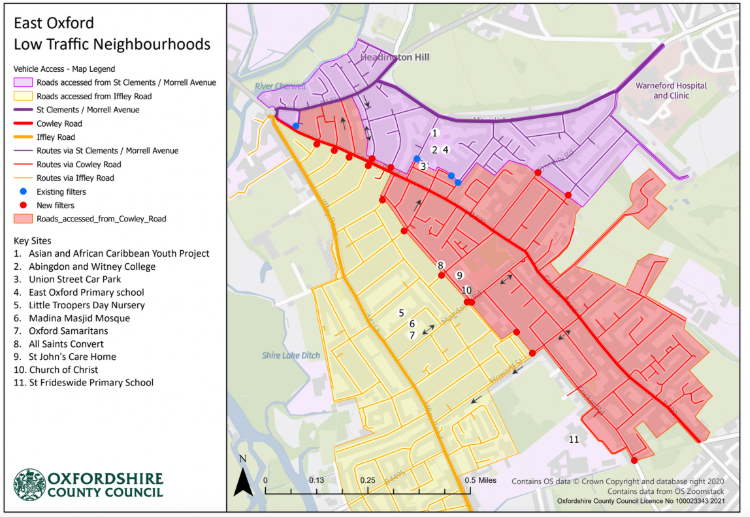
A Low Traffic Neighbourhood (LTN) can take many forms, but the central aim is to limit the amount of through traffic passing through an area. This is most often done through modal filters such as bollards or planters which allow pedestrians and cyclists, but not vehicles, to pass through. Filters have been put in place by residents’ organisations on some Oxford streets already, but without a unified approach the effect is to displace traffic onto surrounding roads (Sustrans, 2023). A formalised LTN approach would place filters on minor roads to ensure all journeys through the area are undertaken on main roads, leaving the rest to be quieter and safer. In East Oxford, three LTNs have been proposed by the County Council, as shown in the Figure 3. Four filters are currently in place, and a further 16 are proposed to create distinct areas and flows of traffic. Analysing the implementation of traffic filters in Austin Texas, policy makers found that the predictability from regular traffic flows was most the important factor for reducing accidents and making streets safer for cars, pedestrians and cyclists (Martin, 2016). Recently LTN’s have appeared in (inter)national news alongside misleading claims about their purpose, and have become a contentious idea as a result of this coverage. Some arguments were genuine, such as concerns filters would limit passing footfall and therefore would be detrimental to local businesses. Others were less relevant, and popular theories that local authorities wanted to confine populations to particular areas were quickly dismissed (Quinn, 2023). The attention on the proposals slowed progress. However, a community can be effective at restarting dialogue with representatives to provoke change (Maton, 2008; Burk, 2017). An empowered show of support can play a significant role in the Council’s actions and confidence to follow through with the policy. The Marston cycle path closure showed the County Council to be receptive to the needs of the community when raised. If fully embraced and implemented, neighbourhoods could see a reduction in traffic, pollution and accidents, making streets safer and more desirable.

Experimental Traffic Regulation Orders, or ‘Bus Gates’
Similar external criticisms have been levelled against Experimental Traffic Regulation Orders (ETROs), known as Bus Gates. Proposed ETRO’s will mimic the restrictions already in place on the High Street, where only buses, taxis and other commercial vehicles may pass (Allen, 2022). The effect of the High Street bus gate was to significantly reduce traffic in the very centre of Oxford, allowing for the pedestrianisation of key shopping street Cornmarket (Johnson, 2015). The restrictions would prevent through traffic in the city in order to reduce congestion by requiring through journeys to be made via the ring road (Dorling, 2023). Figure 4 shows the proposed locations. After consultation, a number of concessions were made to allow certain groups like carers and commercial vehicles free movement through the filters, which are to be monitored by Automatic Number Plate Recognition (ANPR) cameras and fines issued to unauthorised vehicles. Exemptions will be made for households within these areas, up to three cars per household. In February 2023, large protests took place in Oxford against the Bus Gates, and the issue has stalled (Dorling, 2023). Very little opposition occurred when the High Street restrictions were put in place in the 1980s, and the result was a safer, more pleasant urban environment (Johnson, 2015). Similarly to the LTNs, communities can speak up for what changes they would like to see in their area, and demonstrate the desire for safe and pleasant places to live and work. There are concerns about the capacity of Oxford’s ring road to handle more traffic as a result of fewer journeys through the city, but public transport and cycle-share provisions were included in the County Council’s original proposals, and would go a long way towards solving this. Local authorities can be held accountable to the wishes and needs of their communities to make sure that the proposed changes aren’t perfunctory and make a real difference.


15 Minute Cities
The 15 Minute City Project and proposes that everyone living in an urban setting should be able to access all of the essential services they may need within a 15 minute journey by bike or on foot. This includes community level healthcare and education, amenities, recreation facilities and more. It places blended land use and hyperproximity at the centre, and founder Dan Luscher described it as the urban planning equivalent of human centred design (Luscher, 2020) The are other aspects as well, such as widening pavements and implementing cycle lanes in order to facilitate more non-car travel. Equity is also key, the services should be equally accessible no matter where your live and your journey starts and will be established to rectify existing discrepancies in provision (Moreno, et al., 2021). The 15 Minute City would not make cycling safer directly, but instead imagines a world where more journeys are accessible by bike, and cars are needed less frequently and thus targeting both Net Zero and Vision Zero. It supports Robert Penn’s argument that being surrounded by other cyclists is key to increasing its prevalence. 15 Minute Cities are in contrast to historically dominant principles of urban design, which separate cities into zones for business, retail and residential areas etc. The major changes needed to create hyperlocal communities require input from those communities to be effective. When similar neighbourhoods were development in Portland, Oregon, policy makers were explicit about the need for participatory change, with significant consultation with and input from communities (Flanagan, et al., 2016). The 15 Minute City has not been implemented in any official capacity in Oxford and yet it is the infrastructure proposal from this report which the community can play the largest role in shaping. As with the previous examples of infrastructure change, communities are at the heart of the design decisions in 15 Minute Cities. An empowered community engaging with their authority to ensure infrastructure is designed for them, rather than existing within the confines of it, is a marked change in attitude and has the possibility to improve quality of life in terms of cycling and beyond.
Conclusion
Cycling has the potential to make huge strides towards environmental, physical and mental health. Historically bicycles have played important symbolic roles. The freedoms they enabled through reducing reliance on cars caused women’s rights activist Susan B Anthony in 1896 to say ‘Let me tell you what I think of bicycling. I think it has done more to emancipate women than anything else in the world’ (Hawken, 2017, p. 88). Cycling has the potential to make the same impact with regards to the climate crisis. Oxford is particularly well placed to take advantage of the opportunities cycling offers to meet the aims of reducing car journeys and reducing emissions. However, this can only be achieved if the dangers of cycling are significantly reduced. Community engagement with the three infrastructure changes presented in this report will go a long way towards ensuring that this is the case.
Reference List
Allen, L., 2022. Traffic filters: pre-ETRO survey. DJS Field and Data Services for Oxfordshire County Council, Volume November, pp. 1-73.
Barajas, J. M., 2020. Supplemental infrastructure: how community networks and immigrant identity influence cycling. Transportation, Volume 47, pp. 1251-1274.
Burk, D., 2017. Infrastructure, Social Practice, and Environmentalism: The Case of Bicycle-Commuting. Social Forces, 95(3), pp. 1209-1236.
CycleStreets, 2023. Bikedata. [Online]
Available at: https://bikedata.cyclestreets.net/collisions/#13.52/51.77378/-1.25066
[Accessed 24 October 2023].
Cyclox, 2022. Vision Zero Campaign. [Online]
Available at: https://www.cyclox.org/index.php/2022/09/27/what-is-vision-zero/
[Accessed 25 October 2023].
Dorling, D., 2011. Roads, Casualties and Public Health: the Open Sewers of the 21st Century. London, Parliamentary Advisory Council for Transport Safety’s 21st Westminster Leacture.
Dorling, D., 2023. The Oxford Bus Gates and Open Minds. Oxford Magazine, Volume 451, pp. 14-19.
Dorling, D., 2023. The souls of the people of Oxford. Oxford Magazine, Volume 256, pp. 7-16.
Flanagan, E., Lachapelle, U. & El-Geneidy, A., 2016. Riding tandem: Does cycling infrastructure investment mirror gentrification and privilege in Portland, OR and Chicago, IL?. Research in Transportation Economics, Volume 60, pp. 14-24.
Hawken, P., ed., 2017. Drawdown; the most comprehensive plan ever proposed to reverse gloabl warming. New York: Penguin Books.
Johnson, R. W., 2015. Look Back in Laughter; Oxford’s Postwas Golden Age. 1st Edition ed. Newbury: Threshold Press.
Luscher, D., 2020. Introducing the 15-Minute City Project. Medium, 17 June.
Lusk, A. C. et al., 2011. Risk of injury for bicylcing on cycle tracks versus in the street. Injury Prevention, Volume 17, pp. 131-135.
Martin, E. R., 2016. Wheels of Justice: WIdespread confusion over the rules of the road for bicyclists leads to clashes. American Bar Association Journal, 102(8 (August 2016)), pp. 16-18.
Maton, K. J., 2008. Empowering Community Settings: Agents of Individual Development, Community Betterment, and Positive Social Change. American Journal of Community Psychology, Volume 41, pp. 4-21.
Moreno, C. et al., 2021. Introducing the “15-Minute City”: Sustainability, Resilience and Place Identity in Future Post-Pandemic Cities. Smart Cities, Volume 4, pp. 9-11.
Oxford City Council Scrutiny Committee, 2023. Oxford Local Plan 2040 Regulation 19 Consultation Document. [Online]
Available at: https://mycouncil.oxford.gov.uk/documents/g8096/Agenda%20frontsheet%20Monday%2016-Oct-2023%2018.00%20Scrutiny%20Committee.pdf?T=0
Oxford City Council, 2023. Oxford Major Employers. [Online]
Available at: https://www.oxford.gov.uk/info/20238/oxfords_economy/946/major_employers
[Accessed 25 October 2023].
Oxfordshire County Council, 2023. Additional route made available for cyclists during Marston cycle path closure. [Online]
Available at: https://news.oxfordshire.gov.uk/additional-route-made-available-for-cyclists-during-marston-cycle-path-closure/
[Accessed 25 October 2023].
Oxfordshire County Council, 2023. East Oxford low traffic neighbourhoods (LTNs). [Online]
Available at: https://www.oxfordshire.gov.uk/residents/roads-and-transport/connecting-oxfordshire/low-traffic-neighbourhoods/east-oxford-ltns
[Accessed 26 October 2023].
Penn, R., 2010. It’s All About the Bike: The Pursuit of Happiness on Two Wheels. New York: Bloomsbury.
Prati, G., Fraboni, F., De Angelis, M. & Pietrantoni, L., 2019. Gender differences in cyclists’ crashes: an analysis of routinely recorded crash data. International Journal of Injury Control and Safety Promotion, 26(4), pp. 391-398.
Quinn, B., 2023. Far right trying to infiltrate UK’s low-traffic protests, campaigners warn. The Guardian, 24 February.
Sustrans, 2023. Making the case for a low traffic neighbourhood. [Online]
Available at: https://www.sustrans.org.uk/for-professionals/infrastructure/an-introductory-guide-to-low-traffic-neighbourhood-design/an-introductory-guide-to-low-traffic-neighbourhood-design-contents/design-guide/all/1-making-the-case-for-a-low-traffic-neighbourhood/
[Accessed 25 October 2023].
Walker, P., 2023. Sunak ‘backs drivers’ with curbs on 20mph limits and bus lanes. The Guardian, 29 September.